Spanish A2 Online Classes: Complete Guide to Learning, Speaking, Exams and Career Opportunities

Spanish A2 online classes : Reaching the A2 level in Spanish is an important stage in your language-learning journey. You are no longer limited to introducing yourself or memorising isolated phrases. At A2, you begin using Spanish for everyday situations such as shopping, travelling, describing past experiences, talking about work, making plans and participating in simple conversations.
Spanish A2 online classes are particularly useful for learners who have completed the basics of Spanish and want structured training in speaking, listening, reading, writing, vocabulary and grammar. Students who learn Spanish A2 online can develop these skills through interactive lessons while continuing to study from home or another convenient location.
According to the Common European Framework of Reference for Languages (CEFR), A2 represents an elementary stage at which learners can understand and communicate information related to familiar and routine situations.
This guide explains what you can expect from Spanish A2 online classes, essential vocabulary and grammar, listening and writing development, common mistakes, exam preparation, career applications and how to progress toward B1.
What Is the Spanish A2 Level?
Spanish A2 is the second level of the six-level CEFR framework:
A1 → A2 → B1 → B2 → C1 → C2
A1 introduces the foundations of Spanish, while A2 expands your ability to communicate independently in predictable everyday situations.
An A2 learner should gradually become comfortable discussing:
- family and personal information
- daily routines
- shopping and prices
- food and restaurants
- travel and transportation
- accommodation
- education
- hobbies and interests
- health and appointments
- work and professions
- past experiences
- future plans
- simple social situations
A2 does not mean fluency. Complex discussions and fast native-level conversations may still be difficult. The objective is to become functional in familiar situations and establish the foundation needed for B1.
Understand What You Will Learn at Spanish A2
Before starting Spanish A2 online classes, it is useful to understand exactly what skills and language structures are covered at this stage. Our complete Spanish A2 syllabus explains the vocabulary, grammar, listening, speaking, reading and writing competencies learners develop at A2. Reviewing the syllabus can also help you identify areas that require additional practice before progressing toward B1.
Who Should Join Spanish A2 Online Classes?
Spanish A2 online classes are suitable for learners who have completed Spanish A1 or already possess equivalent basic knowledge.
Before starting A2, you should ideally be able to introduce yourself, ask and answer basic personal questions, understand common everyday vocabulary, use basic present-tense verbs and participate in short conversations.
If you studied Spanish independently and now want to learn Spanish A2 online, taking an A1-level assessment can help identify gaps before moving forward.
A2 Spanish Vocabulary Essentials
Vocabulary development becomes increasingly important during Spanish A2 online classes because learners need to move beyond memorised introductions and basic expressions.
Rather than learning random lists of words, vocabulary should be organised around situations in which you are likely to use Spanish.
Everyday Spanish Vocabulary at A2
An A2 learner should expand vocabulary related to family relationships, household objects, clothing, weather, food, shopping, directions, transportation, health, hobbies, education, occupations and travel.
For example, useful travel vocabulary includes:
el billete – ticket
la estación – station
el equipaje – luggage
la reserva – reservation
el alojamiento – accommodation
el vuelo – flight
Knowing individual words, however, is not enough. During Spanish A2 online classes, students should practise vocabulary inside meaningful sentences:
Quiero reservar una habitación para dos noches.
¿A qué hora sale el tren?
Learning vocabulary in context makes it easier to remember and use during actual conversations.
How Should You Build A2 Spanish Vocabulary?
If you learn Spanish A2 online, combine vocabulary notebooks or flashcards with reading, listening and speaking activities.
Instead of memorising only viaje as "trip," learn expressions such as hacer un viaje, viaje de negocios and viajar por España.
This approach helps you understand how Spanish words naturally work together.
A2 Spanish Grammar Checklist
Grammar is an important component of Spanish A2 online classes because A2 learners need to communicate about more than what is happening right now.
You gradually learn to explain previous experiences, describe current situations, express preferences and discuss plans.
Important A2 grammar areas generally include:
- present-tense revision
- common irregular verbs
- reflexive verbs
- ser and estar
- por and para
- direct and indirect object pronouns
- gustar and similar constructions
- comparisons
- possessive forms
- demonstratives
- common prepositions
- present progressive constructions
- past-tense forms
- talking about plans and future intentions
- commands and everyday instructions
- connectors such as porque, pero, entonces, también and aunque
Students who learn Spanish A2 online should practise these structures through speaking and writing rather than simply memorising conjugation tables.
Grammar should support communication. Being able to correctly describe what you did yesterday is more useful than memorising rules that you cannot apply in conversation.
Common Mistakes A2 Spanish Learners Make
Mistakes are normal at A2 because learners begin creating longer and more spontaneous sentences.
A major benefit of instructor-led Spanish A2 online classes is receiving feedback before frequently repeated mistakes become established habits.
One particularly common problem is confusing ser and estar. Learners may also struggle with gender agreement:
la casa blanca rather than la casa blanco.
Another challenge involves past-tense verb forms. Once students begin describing previous experiences, they must choose appropriate forms rather than relying entirely on the present tense.
Other common problems include:
- translating directly from English
- forgetting adjective agreement
- using incorrect prepositions
- incorrect verb conjugation
- confusing masculine and feminine nouns
- incorrect placement of object pronouns
- using English sentence structures in Spanish
When you learn Spanish A2 online, regular correction from an instructor can help you identify patterns in your mistakes and gradually improve accuracy.
Real-Life Conversations at A2 Level
One of the biggest differences between A1 and A2 should be your ability to handle more realistic conversations.
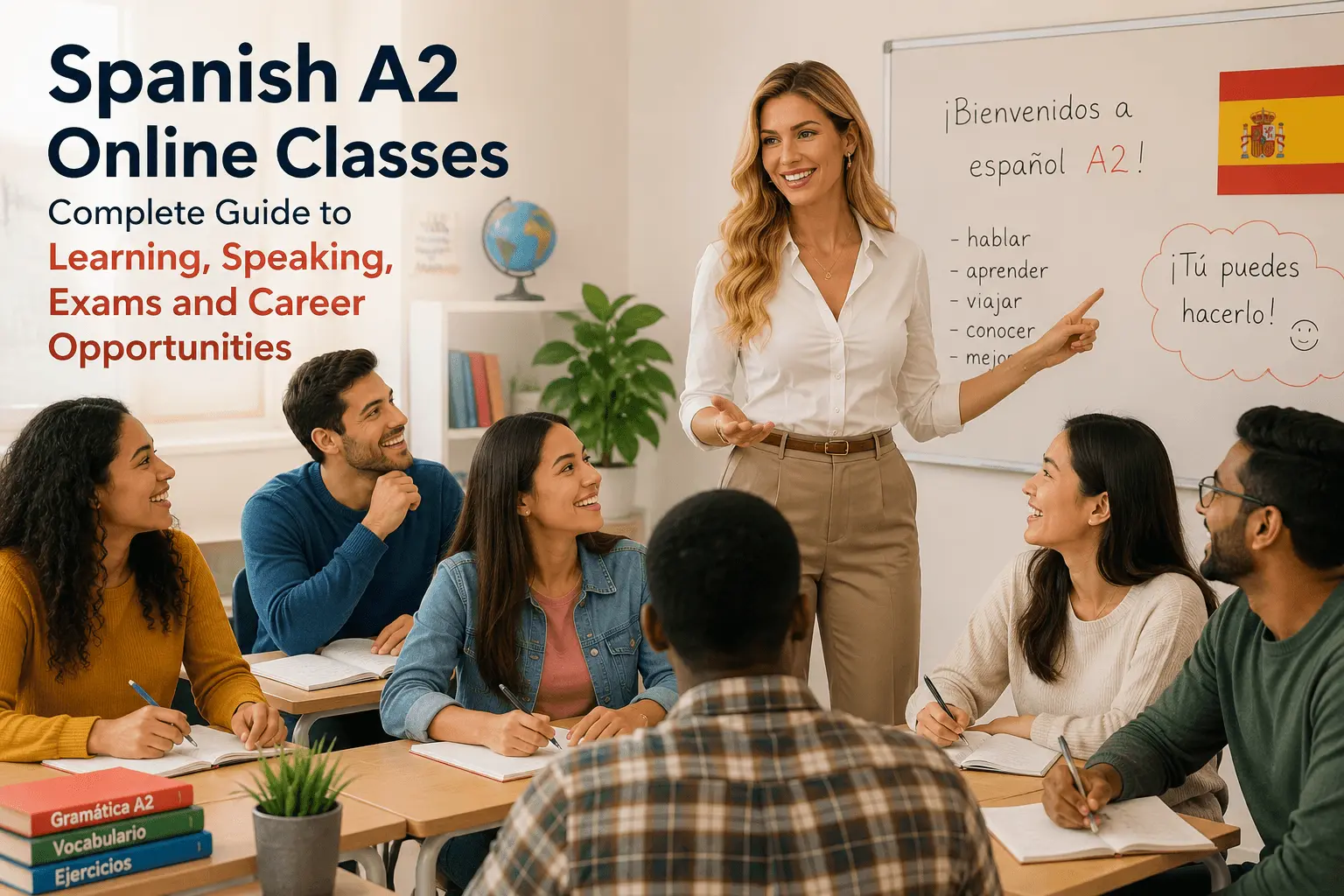
Good Spanish A2 online classes should therefore include practical situations such as ordering meals, checking into a hotel, asking for directions, explaining a simple problem, arranging an appointment, buying tickets, discussing weekend activities and describing previous experiences.
For example:
A: ¿Qué hiciste el fin de semana?
B: Fui a Mysore con mis amigos.
A: ¿Te gustó?
B: Sí, mucho. Visitamos varios lugares y comimos en un restaurante español.
These short exchanges develop the ability to respond spontaneously rather than simply recite memorised answers.
If you learn Spanish A2 online, role plays can be particularly useful because they simulate situations you may encounter while travelling, studying or interacting with Spanish speakers.
A2 Spanish Listening Comprehension Practice
Listening is often one of the most challenging skills for learners.
Classroom Spanish can sound relatively easy because teachers often speak clearly. Real conversations may sound very different because native speakers connect words, use regional expressions and speak at different speeds.
For this reason, listening should form an important part of Spanish A2 online classes.
A2 listening practice can include:
- short conversations
- public announcements
- directions
- restaurant interactions
- travel situations
- telephone conversations
- simple interviews
- everyday social exchanges
A useful method is to listen to the same short recording several times.
During the first listening, identify the general topic. During the second, listen for names, numbers, locations and important actions. During the third, concentrate on unfamiliar vocabulary and sentence structures.
Students who learn Spanish A2 online should avoid trying to translate every word. Understanding the overall meaning despite missing some vocabulary is an important listening skill.
Spanish A2 Writing Skills Development
Writing at A2 moves beyond isolated sentences.
Spanish A2 online classes should introduce students to short emails, messages, invitations, descriptions, travel experiences, personal stories and simple requests.
For example:
Hola María:
El fin de semana pasado fui a Goa con mi familia. Nos alojamos cerca de la playa y visitamos varios lugares. El tiempo fue fantástico y la comida me gustó mucho.
Writing activities like this combine vocabulary, grammar and sentence organisation.
A useful writing process is:
Plan → Write → Correct → Rewrite
When students learn Spanish A2 online, submitting written work for correction can help them recognise recurring mistakes involving grammar, spelling, vocabulary and sentence structure.
Follow a Structured Spanish A2 Course
A structured learning programme can make the transition from beginner Spanish to A2 considerably easier. Explore our Spanish A2 course if you want to understand how A2 learning can be organised around grammar, vocabulary and practical communication skills. Following a defined course structure also makes it easier to track your progress and identify what you need to improve before moving to Spanish B1.
A2 Spanish Cultural Context Learning
Language and culture cannot be completely separated.
Spanish is spoken across Spain and much of Latin America, and vocabulary, pronunciation and everyday expressions can vary between regions.
Good Spanish A2 online classes should therefore introduce learners to Spanish-speaking cultures rather than teaching the language entirely in isolation.
Lessons can incorporate topics such as:
- Spanish-speaking countries
- food traditions
- greetings
- social etiquette
- festivals
- daily schedules
- regional expressions
- differences in commonly used vocabulary
Students who learn Spanish A2 online do not need to master every regional variation. However, exposure to different accents and cultural contexts can prepare them for more authentic communication.
How to Prepare for A2 Spanish Exams
Learners who want formal proof of their language ability may prepare for an A2-level examination such as DELE A2.
Students can use Spanish A2 online classes to strengthen the four major language skills required for examination preparation: reading, listening, writing and speaking.
Good exam preparation should include more than grammar revision.
Students should practise:
- timed reading exercises
- listening for specific information
- writing according to task requirements
- describing familiar situations
- answering questions orally
- participating in simulated conversations
- working with examination-format exercises
If you learn Spanish A2 online specifically for certification, include official sample materials and timed practice in your study routine.
Preparing for the Spanish A2 Examination
Learners working toward an A2 qualification should become familiar with the skills they may need to demonstrate in an examination environment. Our guide to the Spanish A2 exam provides additional information for students who want to understand the examination and prepare their Spanish systematically. Combine exam-focused preparation with regular listening, reading, writing and speaking practice rather than relying only on grammar revision.
How to Measure Your A2 Spanish Progress
Progress should not be measured only by the number of grammar chapters completed.
Instead, evaluate what you can actually do in Spanish.
During Spanish A2 online classes, periodically ask yourself whether you can:
- understand the main information in a short everyday conversation
- describe something you did recently
- make simple travel arrangements
- write a short email
- order food
- ask for directions
- explain basic preferences
- participate in a short conversation without preparing every sentence
Keeping a monthly speaking recording can also be useful. Record yourself discussing similar topics every few weeks and compare your vocabulary, sentence length, accuracy and hesitation.
When you learn Spanish A2 online, these practical measurements often provide a clearer picture of progress than test scores alone.
Combining Multiple Learning Methods for A2 Spanish
There is no single learning method that develops every language skill equally well.
The most effective Spanish A2 online classes can be combined with:
Structured lessons + speaking + listening + reading + vocabulary revision + writing
Online classes provide structure and teacher feedback. Apps and flashcards can support vocabulary revision. Podcasts and videos improve listening. Conversation sessions develop speaking confidence. Reading introduces vocabulary in context.
Students who learn Spanish A2 online should therefore use different learning methods to reinforce one another.
For example, vocabulary introduced during class can later be revised with flashcards, encountered while reading and deliberately used during speaking practice.
Cost Comparison of Spanish Learning Methods
The cheapest learning method is not necessarily the most cost-effective.
Free videos and apps can provide supplementary practice at little or no cost, but they may offer limited personalised feedback.
Recorded courses provide greater structure but usually offer less interaction.
Group Spanish A2 online classes can provide structured instruction, interaction with other learners and teacher feedback while generally remaining more affordable than private one-to-one tuition.
One-to-one classes provide maximum individual attention but typically cost more.
Before deciding where to learn Spanish A2 online, compare course structure, speaking opportunities, teacher support, class size and learning outcomes rather than considering price alone.
A learner who needs speaking improvement may gain more from interactive lessons than from purchasing several self-study resources.
Spanish Vocabulary for Different Job Sectors
Spanish can become increasingly useful professionally as your proficiency improves.
Career-oriented Spanish A2 online classes can introduce vocabulary connected with different industries while continuing to develop general language ability.
Customer Service
cliente – customer
pedido – order
problema – problem
devolución – return/refund
ayuda – help
Sales and Marketing
ventas – sales
cliente potencial – potential customer
mercado – market
publicidad – advertising
descuento – discount
Hospitality and Tourism
huésped – guest
reserva – reservation
habitación – room
recepción – reception
visita guiada – guided tour
IT and Business Services
reunión – meeting
proyecto – project
equipo – team
usuario – user
soporte técnico – technical support
Professionals who learn Spanish A2 online can supplement general A2 vocabulary with terminology connected to their existing occupation.
A2 Spanish Level Requirements by Industry
A2 can be useful professionally, but learners should maintain realistic expectations.
Completing Spanish A2 online classes does not automatically provide the language proficiency required for every Spanish-speaking job.
Jobs requiring extensive client communication, negotiation, translation, teaching or professional writing will generally require considerably stronger Spanish.
A2 is better viewed as an early professional advantage rather than full professional proficiency.
It can be useful when Spanish is an additional skill rather than the primary working language—for example, understanding simple requests, greeting Spanish-speaking customers, handling routine interactions or supporting colleagues.
Professionals who learn Spanish A2 online for career development should normally plan to continue toward B1 and B2, particularly for positions involving regular Spanish communication.
Real Job Market Opportunities for Spanish Speakers
Spanish is an international language used across many countries and industries, creating potential opportunities in areas such as:
- customer support
- tourism
- hospitality
- international business
- sales
- localisation
- education
- global service operations
However, job advertisements vary significantly in their language requirements.
Employers rarely hire someone merely because a CV says "Spanish A2." They evaluate whether the candidate's actual communication ability is sufficient for the position.
For this reason, Spanish A2 online classes should be viewed as one stage in developing a professional language skill.
A learner with A2 Spanish plus existing expertise in IT, finance, sales, hospitality or another profession may find Spanish useful as an additional competency.
Online Jobs That May Be Accessible With A2 Spanish
Some remote roles may value elementary Spanish when the primary working language is English or another language.
Potential areas can include:
- basic multilingual support
- travel assistance
- content-related work
- administrative tasks
- entry-level customer support
- certain data-related roles
However, there is no universal A2 requirement for these positions.
Students taking Spanish A2 online classes specifically for employment should carefully read individual job descriptions to determine the required proficiency.
If an advertisement says "Spanish required," check whether the employer expects elementary communication, conversational fluency or professional proficiency.
How to Leverage A2 Spanish on Your Resume
If you have genuinely reached A2, state your proficiency accurately.
For example:
Spanish – A2 (Elementary), CEFR
If you completed Spanish A2 online classes, you can mention your training separately where appropriate, particularly if the course included assessments or certification.
If you hold a recognised certification, mention the qualification separately.
Avoid writing "fluent Spanish" if your actual proficiency is A2. An employer may assess your Spanish during an interview.
You can also describe practical ability:
Spanish: A2 – able to handle basic everyday conversations and routine written communication.
Students who learn Spanish A2 online for career purposes should focus on demonstrating genuine communication ability rather than exaggerating their proficiency.
Common Interview Questions in Spanish With English Translations
Preparing for simple interview questions can help A2 learners develop professional confidence.
Háblame de ti.
Tell me about yourself.
¿Dónde trabajas actualmente?
Where do you currently work?
¿Por qué quieres trabajar aquí?
Why do you want to work here?
¿Cuáles son tus puntos fuertes?
What are your strengths?
¿Qué experiencia tienes?
What experience do you have?
¿Por qué estudias español?
Why are you studying Spanish?
Students attending Spanish A2 online classes can practise these questions through role plays.
For example:
¿Por qué estudias español?
Estudio español porque trabajo con clientes internacionales y quiero mejorar mis oportunidades profesionales.
When you learn Spanish A2 online, the objective at this stage should be to answer clearly and correctly rather than trying to use unnecessarily complicated vocabulary.
Spanish Language Certifications Employers May Recognise
One of the best-known formal Spanish qualifications is DELE, which corresponds to CEFR proficiency levels and includes A2.
However, completing Spanish A2 online classes and obtaining a language certificate are not necessarily the same thing. A course helps you develop proficiency, while an external examination can provide formal evidence of your level.
Not every employer requires DELE. Some organisations conduct their own language assessments, while others may accept different forms of evidence.
Therefore, before paying for a certification specifically for employment, check the requirements of the employers, universities or immigration processes you are targeting.
Learners who learn Spanish A2 online can decide whether certification is necessary according to their individual goals.
Work-Study Opportunities in Spain
Students considering study and employment in Spain should research the immigration conditions applicable to their nationality, programme and residence status before making plans.
Knowing Spanish can make everyday life easier and may broaden the range of opportunities available, but A2 alone should never be treated as a guarantee of employment.
Spanish A2 online classes can provide an initial communication foundation for students preparing to live or study in a Spanish-speaking environment.
Learners planning to study in Spain can learn Spanish A2 online before travelling and then continue developing toward B1 or B2, particularly if they want employment involving frequent interaction with Spanish-speaking customers or colleagues.
Because immigration and work regulations can change, always verify current requirements through official Spanish government sources.
Career Opportunities After Reaching Spanish A2
It would be misleading to promise that completing A2 automatically leads to employment.
A professional who already works in customer service, for example, may use Spanish A2 online classes to develop enough Spanish to handle some basic interactions with Spanish-speaking customers.
Progressing toward B1 or B2 can subsequently prepare that learner for more communication-intensive responsibilities.
Similarly, someone working in tourism may initially use Spanish for greetings, directions, bookings and simple customer questions.
The strongest career combination is usually:
Spanish + Existing Professional Skills
Therefore, professionals who learn Spanish A2 online should consider how Spanish complements their existing qualifications and experience.
Is A2 Spanish Enough to Get a Job?
Sometimes, but it depends heavily on the position.
If Spanish is an additional advantage, A2 may strengthen your profile. If Spanish is the primary working language, A2 will usually be insufficient for complex professional communication.
Learners taking Spanish A2 online classes for career development can view their progression approximately as:
A1 → Foundation
A2 → Everyday communication
B1 → Growing independence
B2 → Stronger professional communication
C1/C2 → Advanced proficiency
These levels should not be interpreted as universal employment requirements because individual occupations and employers have different expectations.
Explore Spanish Online Learning Options
Students have different reasons for learning Spanish, including travel, higher education, employment, relocation and personal interest. If you want to explore learning options beyond A2, our Spanish online classes page provides information about studying Spanish through online learning. This can be useful for learners who want to learn Spanish online while balancing work, university or other commitments.
How Spanish A2 Online Classes Can Help You Progress
Well-designed Spanish A2 online classes should connect grammar with real communication.
Students should not finish A2 knowing hundreds of grammar rules but still being afraid to speak.
Effective classes should provide opportunities to:
- listen and respond
- ask and answer questions
- describe experiences
- write short messages
- practise role plays
- participate in conversations
- receive corrections
- improve pronunciation
Teacher feedback is particularly valuable at A2 because learners begin producing considerably more original language.
If you learn Spanish A2 online through interactive classes, make active participation an important part of your learning process.
Building a Study Routine for Spanish A2
Consistency is more valuable than occasional intensive study.
A learner attending Spanish A2 online classes can supplement lessons with short daily activities.
Spend some days revising vocabulary and grammar, but also dedicate time specifically to listening and speaking. Read short Spanish texts, write small paragraphs about your day and regularly review corrected mistakes.
Even 20–30 minutes of focused practice outside class can reinforce what you learn during lessons.
Students who learn Spanish A2 online should try to bring Spanish into everyday life through music, podcasts, videos, reading and conversation.
Most importantly:
Use Spanish rather than only studying Spanish.
What Comes After Spanish A2 Online Classes?
After completing Spanish A2 online classes, the natural next step is Spanish B1.
B1 represents a significant transition toward independent language use. Students begin discussing a broader range of topics, expressing opinions in greater detail, understanding longer conversations and communicating with greater flexibility.
Learners who learn Spanish A2 online and establish strong vocabulary, grammar and speaking habits are generally better prepared for the transition to B1.
For this reason, do not rush through A2 simply to reach the next certificate.
Build the foundation properly.
Why Learn Spanish A2 Online?
Choosing to learn Spanish A2 online can provide flexibility for students, professionals and other learners who may find regular classroom attendance difficult.
Interactive Spanish A2 online classes can combine live teaching, speaking activities, grammar explanations, listening exercises, writing correction and digital learning materials within one structured programme.
Online learning can also eliminate commuting time and make it easier to maintain a consistent schedule.
However, the effectiveness of online learning depends heavily on participation. Simply attending a class is not enough. Students need to speak, complete assignments, revise vocabulary and practise outside lessons.
When you learn Spanish A2 online, treat your lessons as the foundation of a broader learning routine rather than your only exposure to Spanish.
Frequently Asked Questions About Spanish A2 Online Classes
1. What can I do with A2-level Spanish?
At A2 level, you can handle many predictable everyday situations in Spanish. You should be able to introduce yourself, discuss your family and work, order food, shop, ask for directions, make simple travel arrangements and describe basic past experiences. Spanish A2 online classes can help you develop these practical skills while preparing you for the B1 level.
2. How long does it take to reach A2 Spanish?
The time required depends on your starting level, lesson frequency, previous language-learning experience and the amount of practice you do outside class. Someone who has already completed A1 will generally progress much faster than a complete beginner. When you learn Spanish A2 online, regular speaking, listening and vocabulary practice between lessons can significantly improve your progress.
3. Is Spanish A2 considered beginner or intermediate?
A2 is generally classified as an elementary or basic-user level under the CEFR framework. It is above A1 but below B1. You can communicate in familiar situations, but you are not yet an independent or fluent Spanish speaker.
4. What is the difference between A1 and A2 Spanish?
A1 focuses on very basic communication, such as introductions, numbers, simple questions and everyday expressions. At A2, you expand your vocabulary and grammar and begin discussing past experiences, plans, travel, work and everyday problems. Spanish A2 online classes therefore involve considerably more communication than an introductory A1 course.
5. What is the difference between A2 and B1 Spanish?
A2 allows you to communicate in familiar and predictable situations, while B1 represents a significant move toward independent language use. At B1, you can generally sustain longer conversations, explain opinions and deal with a broader range of situations. Students completing A2 should therefore view B1 as the natural next stage.
6. How difficult is Spanish A2?
Spanish A2 is manageable for learners with a solid A1 foundation, but it introduces new challenges. Past-tense structures, object pronouns, longer conversations and faster listening can initially be difficult. Regular practice during and outside Spanish A2 online classes makes these areas easier over time.
7. What grammar should I know at Spanish A2 level?
A2 learners should develop their understanding of present-tense verbs, common irregular verbs, reflexive verbs, ser and estar, por and para, object pronouns, comparisons, possessives, prepositions and important past-tense constructions. Grammar should be practised through real sentences and conversations rather than memorised only as rules.
8. How much vocabulary should an A2 Spanish learner know?
There is no single vocabulary number that guarantees A2 proficiency. What matters more is whether you can understand and use vocabulary related to everyday subjects such as family, food, shopping, work, transportation, travel, health, hobbies and accommodation. When you learn Spanish A2 online, concentrate on vocabulary you can actually use in sentences.
9. How can I improve my Spanish listening at A2 level?
Listen to short Spanish conversations, beginner-friendly podcasts, announcements, interviews and videos regularly. First try to understand the overall meaning and then listen again for specific information. Students taking Spanish A2 online classes should combine classroom listening exercises with regular independent exposure to spoken Spanish.
10. How can I improve my Spanish speaking at A2?
Speak as frequently as possible. Practise describing your day, discussing weekend activities, ordering food, asking questions and talking about past experiences. Role plays and instructor-led conversations during Spanish A2 online classes can help transform passive vocabulary into active speaking ability.
11. Can I learn Spanish A2 online?
Yes. You can learn Spanish A2 online through live instructor-led classes, self-study resources or a combination of both. Interactive classes are particularly useful for learners who need structured grammar instruction, speaking practice, pronunciation correction and feedback on mistakes.
12. Can I learn Spanish A2 while working full-time?
Yes. Many working professionals study Spanish alongside their jobs. A manageable routine could combine scheduled Spanish A2 online classes with short periods of vocabulary, listening or speaking practice throughout the week. Consistency is generally more useful than studying intensively only once every few weeks.
13. What's the fastest way to learn Spanish A2?
There is no reliable shortcut, but you can make learning more efficient by combining structured lessons, daily vocabulary review, listening practice, speaking and regular correction. Students who learn Spanish A2 online should use Spanish actively instead of spending all their study time reading grammar explanations.
14. Can I learn Spanish A2 through self-study?
It is possible, especially if you are disciplined. Apps, textbooks, videos and podcasts can provide useful resources. However, self-study may provide limited speaking correction and feedback. Combining self-study with Spanish A2 online classes or regular conversation practice can provide a more balanced approach.
15. How do I know if I have reached Spanish A2?
Instead of judging your level only by the chapters you have completed, evaluate what you can actually do. Can you understand short everyday conversations, describe a recent experience, write a simple message, order food, make travel arrangements and participate in a basic conversation? A structured CEFR-aligned assessment can provide a more formal evaluation.
16. What are the most common mistakes Spanish A2 learners make?
Common mistakes include confusing ser and estar, incorrect adjective agreement, translating directly from English, using incorrect prepositions, choosing the wrong past-tense form and incorrectly positioning object pronouns. Regular feedback during Spanish A2 online classes can help identify these patterns before they become habits.
17. How can I build confidence speaking Spanish at A2?
Start with familiar subjects rather than waiting until your Spanish is perfect. Talk about yourself, your family, hobbies, work, food, travel and daily activities. Accept that mistakes are part of learning. Frequent short conversations are usually more useful for building confidence than occasionally attempting a very long conversation.
18. Should I take Spanish classes before applying for jobs abroad?
If Spanish is relevant to the positions you are targeting, improving your ability before applying can strengthen your profile. Spanish A2 online classes can provide a basic communication foundation, but positions requiring regular professional communication may expect B1, B2 or higher proficiency.
19. Is A2 Spanish good enough to get a job?
It can be useful for some positions, but A2 alone does not guarantee employment. A2 Spanish is more likely to help when Spanish is an additional skill rather than the primary language of the job. Positions involving negotiation, complex customer communication, teaching or professional writing generally require a higher level.
20. What jobs can I get with A2-level Spanish?
Opportunities depend more on your overall professional skills than your Spanish level alone. Basic Spanish may complement roles in tourism, hospitality, customer support, administration, sales support and international businesses. Completing Spanish A2 online classes should therefore be viewed as adding a skill to your professional profile rather than qualifying you automatically for a particular job.
21. Can I put A2 Spanish on my resume?
Yes, provided A2 accurately reflects your ability. You can write something such as "Spanish – A2 (Elementary), CEFR." Avoid describing yourself as fluent if your actual level is A2 because an employer may test your Spanish during the interview.
22. How should I honestly describe my Spanish level to employers?
Use a recognised framework such as CEFR and describe your practical ability. For example: "Spanish – A2: able to handle basic everyday conversations and routine written communication." This provides employers with more information than simply writing "basic Spanish."
23. Is A2 Spanish enough for a customer service job?
It depends on how much Spanish the role requires. A2 may be sufficient for a limited number of predictable interactions, but a customer service position requiring complex problem-solving entirely in Spanish will generally require stronger proficiency. Always check the individual employer's requirements.
24. Is A2 Spanish enough to work in tourism or hospitality?
A2 can help with basic greetings, reservations, directions and routine customer interactions. However, positions requiring detailed explanations, complaint handling or extensive customer conversations may require B1 or B2. Hospitality professionals can use Spanish A2 online classes as a foundation and continue developing job-specific Spanish.
25. Can I work in Spain with only A2 Spanish?
Language requirements depend on the employer and occupation. Some international workplaces may operate mainly in English, whereas jobs involving Spanish-speaking customers or colleagues can require considerably stronger Spanish. Employment and immigration eligibility are separate issues, so learners should also check current Spanish work and residence requirements.
26. Should I learn Spanish before moving to Spain?
Learning Spanish before moving can make everyday activities such as shopping, transportation, appointments, accommodation and social interaction easier. Choosing to learn Spanish A2 online before relocating can provide a useful foundation, although continuing toward B1 or B2 can make independent communication considerably easier.
27. How do I prepare for a job interview in Spanish at A2 level?
Practise short answers to predictable questions such as Háblame de ti (Tell me about yourself), ¿Qué experiencia tienes? (What experience do you have?) and ¿Por qué quieres trabajar aquí? (Why do you want to work here?). At A2, concentrate on giving clear and accurate answers instead of trying to use complicated vocabulary.
28. Is DELE A2 worth taking?
DELE A2 can be useful when you need formal evidence of your Spanish proficiency for a particular academic, professional, administrative or personal purpose. However, not every employer requires certification. Before taking an examination, check whether the organisation you are targeting actually requires or values a formal Spanish qualification.
29. How can I go from A2 to B1 Spanish?
After completing Spanish A2 online classes, increase your exposure to longer conversations, reading materials and speaking practice. Expand your vocabulary, strengthen past-tense usage, practise expressing opinions and gradually reduce your dependence on translation. B1 requires greater independence, so active language use becomes increasingly important.
30. How long does it take to go from A2 to fluent Spanish?
There is no universal timeline because "fluent" can mean different things. Progress depends on lesson frequency, practice, exposure, motivation and the level of fluency you want to achieve. Instead of focusing only on fluency, progress systematically from A2 to B1, then B2 and beyond. Students who learn Spanish A2 online should treat A2 as an important foundation rather than the final stage of learning Spanish.
Final Thoughts on Spanish A2 Online Classes
Spanish A2 online classes represent an important transition from beginner Spanish toward practical everyday communication.
At this level, students should develop more than vocabulary and grammar. They should become capable of listening to everyday Spanish, writing short messages, describing experiences, handling routine conversations and communicating with increasing independence.
A2 can also provide an early advantage for travel, study and certain professional situations. However, learners whose goal is to work extensively in Spanish should consider A2 a stepping stone toward B1, B2 and potentially higher levels.
The most effective Spanish A2 online classes combine structured teaching with vocabulary development, grammar practice, listening, speaking, writing, cultural exposure and regular real-world use.
If your goal is to learn Spanish A2 online, focus not only on completing the course but also on what you can actually do with the language.
When these elements work together, completing Spanish A2 online classes becomes more than finishing another course level. It becomes a meaningful step toward using Spanish confidently in everyday situations and building the foundation for more advanced Spanish.
Still at A1? Strengthen Your Foundation First
If some of the vocabulary, grammar or conversations covered at A2 still feel difficult, revisiting A1 can be more effective than rushing into the next level. Our Spanish A1 online classes guide explains the beginner-level foundation students should develop before progressing to A2. A strong A1 foundation can make Spanish A2 online classes easier to follow and help you participate more confidently in speaking activities.
Understanding Spanish Language Certification
Completing a course and obtaining a recognised language qualification are related but different goals. If certification is important for your academic, professional or personal plans, read our guide to Spanish language certification to understand certification pathways and how they relate to Spanish proficiency levels. Students taking Spanish A2 online classes can then decide whether they need formal certification or simply want to continue developing their language ability.
Learn Spanish With IIFLS
Learning Spanish is a gradual journey from basic communication at A1 and A2 toward increasingly independent language use at B1, B2 and advanced levels. At the Indian Institute of Foreign Languages (IIFLS) , learners can explore foreign-language learning programmes and resources according to their goals. If you are currently planning to learn Spanish A2 online, focus on building strong speaking, listening, reading, writing, grammar and vocabulary skills before progressing to the next CEFR level.
The University of Salamanca Spanish Courses are a strong external reference for students who want to understand how Spanish is taught in an academic environment. The university offers Spanish programs across learning levels and specifically lists online Spanish courses at A2, B1, B2 and C1 levels. Students progressing through Spanish A2 can use university-level resources like these to explore further language study, cultural immersion and advanced Spanish learning opportunities.
University of Granada — Modern Languages Centre
Students can also explore the University of Granada Modern Languages Centre , one of the university's dedicated centres for language education. Its Spanish programs cover A1 through C2 and follow the Common European Framework of Reference for Languages (CEFR), making the resource particularly relevant for learners who want to understand how Spanish A2 fits into the broader European proficiency framework.
Related Posts