German False Friends: Words That Look Like English but Mean Something Else
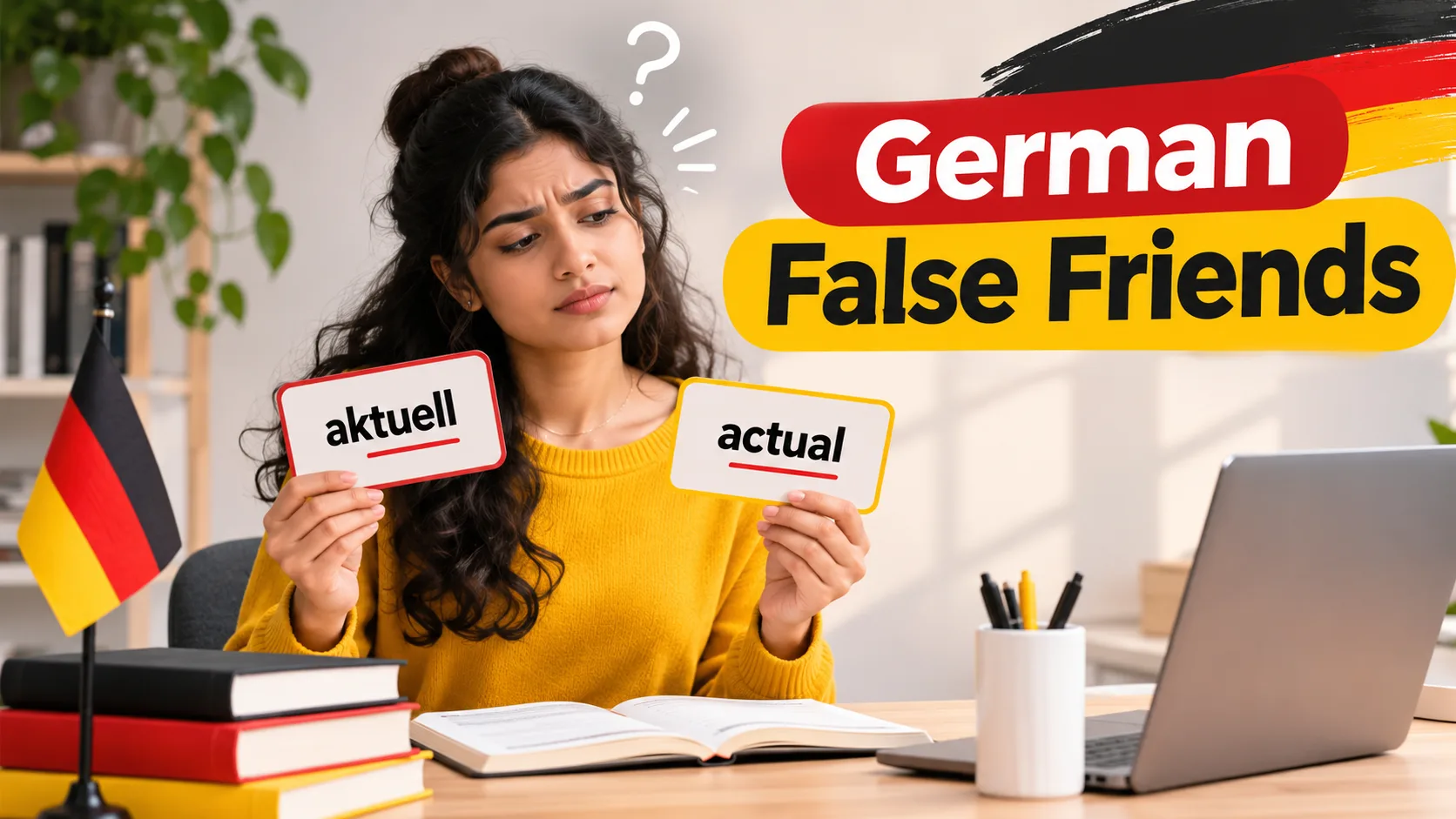
Have you ever seen a German word that looks so familiar, you think you already know what it means? It happens quite frequently when you are learning German, especially when you know English. For instance, the German word Gift does not mean a present for a birthday, it actually means poison!
Those types of words are called German False Friends. They seem to be German English words but they aren't. Even if English and German resemble one another it is possible to confuse somebody by English sing everything you say.
Whether you're learning German for university, for work, for travel or just for fun, it's helpful to be aware of these vocabulary distinctions. In this post, we'll explore 20 frequently confused words with examples and mnemonic aids to learn the right meanings easily.
What Are False Friends in German and English?
False friends, or ‘falsche Freunde’ in German, are words that appear or sound the same in two languages but have different meanings.
For example:
- Das Gift: Poison, not a present.
- Der Chef: Boss, not a cook.
- Bekommen: To receive, not to become.
These similarities can lead learners to feel confident about a word before they know the word's real meaning.
If you are just starting your language learning process, have a look at the German language course to get an idea of the vocabulary progression through the different stages of proficiency.
Why Are There False Friends in German and English?
German and English are Germanic languages . Many words have similar spellings and meanings because they have a common linguistic history.
For example Haus means house, Wasser means water and Name means name. These similarities often facilitate learning vocabulary.
But some words shifted their meanings over time. Some were appropriated and converted for other purposes. That’s why a word that appears familiar may not always mean what you think it does.
20 Common German False Friends You Should Know
The following table compares commonly confused German words with their actual meanings and English lookalikes.
German word | Actual English meaning | Common confusion |
das Gift | Poison | Gift |
der Chef | Boss | Chef |
bekommen | To receive | Become |
aktuell | Current | Actual |
eventuell | Possibly | Eventually |
das Handy | Mobile phone | Handy |
sensibel | Sensitive | Sensible |
bald | Soon | Bald |
der Brief | Letter | Brief |
das Boot | Boat | Boot |
brav | Well-behaved | Brave |
also | So or therefore | Also |
die Fabrik | Factory | Fabric |
die Billion | Trillion | Billion |
das Gymnasium | Academic secondary school | Gymnasium |
die Mappe | Folder | Map |
die Kost | Food or fare | Cost |
spenden | To donate | Spend |
hell | Bright | Hell |
der Rat | Advice or council | Rat |
Some words have additional meanings depending on the context. You can use the Cambridge German–English Dictionary to check unfamiliar vocabulary before using it.
How do false friends result in everyday misunderstandings?
1. Gift vs Geschenk
In German, gift means poison and geschenk means a present.
Example:
Ich habe ein Geschenk für dich.
Meaning: I have a present for you.
Replacing Geschenk by Gift would completely change the meaning of the sentence.
2. Bekommen vs Werden
The verb bekommen means to get, to receive. The German for “become” is wer den.
The following is a humanized version of the text above in English, keeping the meaning and tone but not adding or omitting any information. No other text should be included in the output. Examples:
Examples:
- Ich bekomme eine E-Mail. — I receive an email.
- Ich möchte Arzt werden. — I want to become a doctor.
This distinction is particularly useful in discussions of education, career plans and professional goals.
3. Chef vs Koch
Imagine someone in Germany tells you that their Chef is coming to the office. They are talking about their boss, not about a cook.
Examples:
- Mein Chef ist heute im Büro. — My boss is in the office today.
- Er arbeitet als Koch. — He works as a cook.
4. Eventuell vs Eventually
The German word eventuell does not mean certainty, but possibility.
Ich komme eventuell morgen.
Meaning: I might come tomorrow.
This is the difference you should know when you book appointments or set up meetings.
5. Handy vs Handy
Handy is an English word for useful or convenient. The German word for mobile phone is Handy.
Wo ist mein Handy?
Meaning: Where is my mobile phone?
Such words you learn in everyday conversations, and they are easier to remember. Students can also have a look at the German A2 level course which teaches vocabulary concepts related to the topic.
Where are these vocabulary mistakes most prevalent?
False friends can be found in situations that learners often encounter.
At the office
Words like Chef, aktuell and eventuell help employees make sense of instructions at work and discussions in meetings.
While travelling
You may hear words like Boot, Handy and bald in the course of everyday conversations, asking questions or making travel arrangements.
While studying
Students who prepare assignments or communicate with teachers should understand the terms such as Brief, Mappe and Gymnasium correctly.
The syllabus and training programme of the German language course can help learners to develop basic vocabulary in these situations.
How to avoid false friends mistakes?
There is no need to learn every confusing word all at once. A couple of consistent learning habits can make a noticeable difference.
- Learn words in sentences: Learn vocabulary in use instead of rote isolated translations.
- Make comparison flashcards Write the German meaning on one side and the English word that is confusing on the other.
- Use reliable dictionaries: Use Duden etc. to look up words you don’t know.
- Practice speaking: try to use the new words in brief conversations
- Keep a vocabulary notebook: Make a list of mistakes and frequently review their correct meanings.
For learners who like to practice with an instructor, you can try out the German classes online and in classroom settings in Bangalore to improve your communication skills.
Quick Quiz: Test Your Vocabulary
Choose the right English meaning for each German word.
- Gift — Present or poison?
- Bald — Without hair or soon?
- Fabrik — Fabric or factory?
- Sensibel — Sensible or sensitive?
- Brief — Short or letter?
Answers: 1. Poison, 2. Soon, 3. Factory, 4. Sensitive, 5. Letter.
When you are done with the quiz, try to make a sentence in German with each word.
Frequently Asked Questions
- Are all similar German and English words false friends?
No. Many similar words, such as Finger, Hotel and Computer, share the same or closely related meanings. However, checking unfamiliar vocabulary is always helpful.
- Are false friends important for German A1 learners?
Yeah. As a beginner, you will use English translations a lot. This means you are more likely to misunderstand German words you already know. Knowing these distinctions early can help avoid making the same mistakes again and again.
- What is the easiest way to remember confusing German words?
You can remember words more effectively by learning vocabulary, everyday situations, visual flashcards, and regular revision. You may also want to check out these frequently asked questions about language learning before picking out a suitable course.
- Some of the more common German false friends in English are
Some common examples include Gift, which means poison and not a present, Chef, which means boss and not a cook and Handy, which means mobile phone. You will avoid misunderstanding by learning these words with real-world examples.
- Why does German have so many false cognates with English?
German and English are in the same family of Germanic languages . Many words have similar roots, but their meanings have developed differently. This is why some German words look familiar to English speakers, but mean something entirely different.
- How to avoid the misuse of German false friends?
Do not guess the meaning of a familiar-looking word. Look it up in a reliable German dictionary. Try reading short German texts, listening to everyday conversations and using new vocabulary in simple sentences. Regular practice helps you to understand words in correct context.
Conclusion
Expanding your knowledge of German false friends is an excellent way to increase vocabulary while sidestepping needless confusion. While English and German have enough in common to facilitate learning, there are just as many differences that call for close attention. Study a handful of these commonly confused words every day, use them in sentences, and review them often.
For those who prefer guided lessons, the Indian Institute of Foreign Languages provides German language classes, helping you build vocabulary, grammar and useful conversational skills. Select the course best suited to your current skill and incorporate it into a steady learning habit.
Related Posts