German Business Email Phrases: Greetings, Requests, Follow-Ups, and Sign-Offs
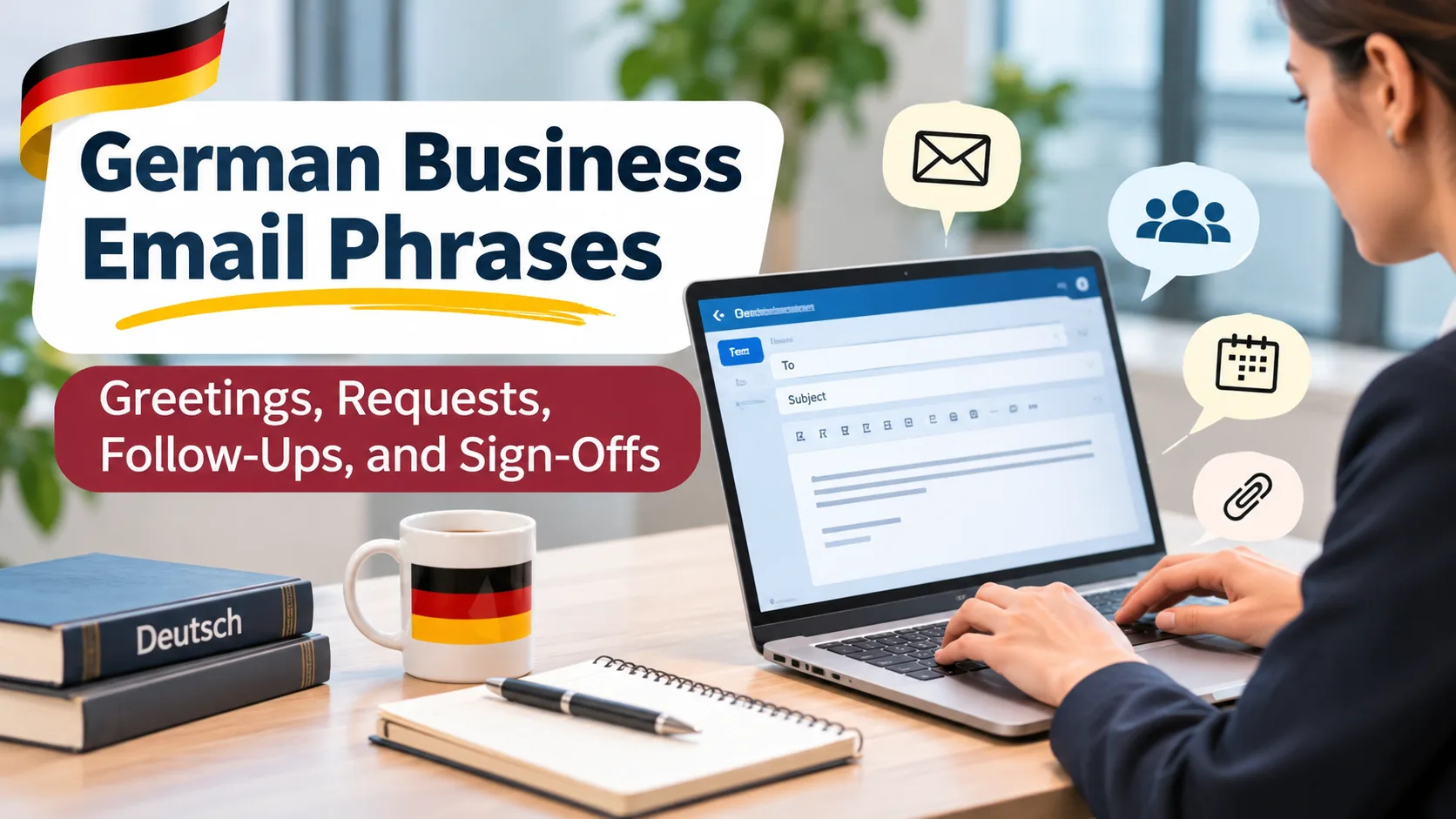
Writing an email in German can be quite daunting, especially if it is the first time you are emailing an employer, university, client or business partner. You may know what you want to say in English but not be able to say the same thing politely in German.
Learning basic German phrases will help you to communicate politely with employers, colleagues, clients and universities. If you are asking for information, making an appointment or sending a follow-up after an interview, using the correct phrases will make writing professional emails easier.
The good news is that you don’t need advanced vocabulary to write a clear business email. Usually some familiar sentence patterns, proper greetings and polite closing expressions are enough. In this guide you will learn how to write professional emails (in German) including examples, English translations and practical tips for beginners.
How Do You Write a Professional Email in German?
Structure of a professional email in German In general, a professional email in German is quite simple in structure. The message should be polite, clear and easy to understand for the recipient.
Email element | German word | Objective |
Subject | Betreff | Explains the goal |
Greeting | Anrede | Addresses the recipient |
Introduction | Einleitung | Introduces the reason for writing |
Main content | Hauptteil | Provides information or requests |
Closing sentence | Schlusssatz | Indicates the next step |
Sign-off | Grußformel | Ends the email politely |
Signature | Signatur | Identifies the sender |
The Goethe-Institut's professional email writing guide recommends polite language, correct spelling and a clear subject line in formal correspondence.
What Are the Best German Greetings for Business Emails?
If learners don’t know common German phrases for professional communication, then they may have a hard time expressing their needs clearly and politely. Rather than translating directly from English, practice short German sentences you can use in the everyday workplace.
German greeting | English meaning | When to use |
Sehr geehrter Herr Müller, | Dear Mr Müller | Formal communication |
Sehr geehrte Frau Weber, | Dear Ms Weber | Formal communication |
Sehr geehrte Damen und Herren, | Dear Sir or Madam | Recipient unknown |
Guten Tag, | Good day | Neutral communication |
Liebe Frau Schmidt, | Dear Ms Schmidt | Established professional relationship |
Liebes Team, | Dear team | Addressing a familiar team |
Notice that German greetings normally end with a comma. The following sentence usually begins with a lowercase letter unless the first word requires capitalisation.
Useful German Phrases for Making Polite Requests
Do you need a document from a colleague or do you want to ask about the admission requirements of a university? I need to ask you something that I don't know if you can help me with but I'm going to try.
The following German sentences are useful in such situations:
German expression | English meaning |
Könnten Sie mir bitte die Unterlagen zusenden? | Could you please send me the documents? |
Wäre ein Termin am Dienstag möglich? | Would an appointment on Tuesday be possible? |
Ich benötige weitere Informationen. | I need further information. |
Bitte bestätigen Sie den Termin. | Please confirm the appointment. |
Dürfte ich Sie um Hilfe bitten? | May I ask you for help? |
Wäre es möglich, die Frist zu verlängern? | Would it be possible to extend the deadline? |
Requests can be softened by phrases such as Könnten Sie or Wäre es möglich. These constructions are related to a German grammatical form called the Konjunktiv II. You can be polite even if your vocabulary is limited.You can still be polite even if your vocabulary is limited.
How to Write Follow-Up Emails in German
Sometimes you don't get an answer to an important email. Do not send a demanding reminder. Write a short message referring to your previous communication.
German expression | English meaning |
Gibt es Neuigkeiten zu meiner Anfrage? | Is there any news regarding my inquiry? |
Haben Sie meine letzte Nachricht erhalten? | Did you receive my last message? |
Ich möchte mich nach dem aktuellen Stand erkundigen. | I would like to inquire about the current status. |
Über eine kurze Rückmeldung würde ich mich freuen. | I would appreciate a brief response. |
Besten Dank für Ihre Unterstützung. | Many thanks for your support. |
If replying to an original subject or date, please mention it. This way the recipient can understand the context without having to go through several previous emails.
German Expressions for Sending Documents and Attachments
Business communication frequently involves sending application forms, invoices, reports and other documents.
Here are some simple expressions you can use:
German expression | English meaning |
Anbei sende ich Ihnen meinen Lebenslauf. | I am sending you my CV as an attachment. |
Die Rechnung finden Sie im Anhang. | You will find the invoice attached. |
Im Anhang finden Sie das ausgefüllte Formular. | The completed form is attached. |
Bitte prüfen Sie die beigefügten Dokumente. | Please review the attached documents. |
Always check whether you have attached the correct file before sending the message.
How Do You End a Business Email in German?
Application forms, invoices, reports and other documents are often sent in business communications.
German sign-off | English meaning |
Mit freundlichen Grüßen | Kind regards |
Freundliche Grüße | Kind regards |
Beste Grüße | Best regards |
Viele Grüße | Many regards |
Herzliche Grüße | Warm regards |
Always check to see that the correct file is attached before sending your message.
German Business Email Examples With English Translations
Example 1: Requesting Information About a Job
Betreff: Anfrage zur ausgeschriebenen Stelle
Sehr geehrte Frau Schneider,
ich interessiere mich für die ausgeschriebene Stelle in Ihrem Unternehmen. Könnten Sie mir bitte weitere Informationen zu den Aufgaben und Anforderungen zusenden?
Vielen Dank für Ihre Unterstützung.
Mit freundlichen Grüßen
Anjali Sharma
English translation:
Subject: Enquiry about the advertised position
Dear Ms Schneider,
I am interested in the advertised position at your company. Could you please send me further information about the responsibilities and requirements?
Thank you for your support.
Kind regards,
Anjali Sharma
Example 2: Following Up After an Interview
Betreff: Rückfrage zum Vorstellungsgespräch
Sehr geehrter Herr Weber,
ich bedanke mich nochmals für das Gespräch am Montag. Ich möchte mich erkundigen, ob es bereits Neuigkeiten zu meiner Bewerbung gibt.
Über eine kurze Rückmeldung würde ich mich freuen.
Mit freundlichen Grüßen
Rahul Kumar
English translation:
Subject: Follow-up regarding the job interview
Dear Mr Weber,
Thank you again for the conversation on Monday. I would like to inquire whether there is any news regarding my application.
I would appreciate a brief response.
Kind regards,
Rahul Kumar
Common Mistakes to Avoid in German Business Emails
Often, beginners tend to translate from English literally, which could either affect the grammar or tone of the sentence.
Some common mistakes include:
- Instead of the formal Sie, many use the informal du when addressing unfamiliar people.
- Fail to capitalise formal pronouns such as Sie, Ihnen and Ihre.
- Adding a comma after the closing expression.
- Write long and complicated sentences that are hard to follow.
- Using an unclear subject line.
- Forgetting to proofread names, dates and attachments.
- You can use free resources for learning German to practice every day.
With regular practice using free German language learning resources you will become more familiar with everyday vocabulary and sentence formation.
How Can Beginners Improve Their German Email Writing Skills?
Start with short messages instead of attempting complicated business correspondence immediately.
Practise writing one email every day. Change the situation, recipient and purpose to become familiar with different sentence patterns. For example, write an appointment request on Monday, a document enquiry on Tuesday and a follow-up email on Wednesday.
You can also use the Goethe-Institut's A1 email writing materials for additional practice.
Frequently Asked Questions
Can A1 learners write formal e-mails in German?
A1 learners are able to write short formal messages using familiar vocabulary, basic greetings, requests for appointments and simple closing expressions.
2. hould I write business emails using Sie or du?
Use Sie for clients, employers and officials you don't know. Use du when there has been an informal relationship already, or when workplace norms permit.
3. Can you learn German email writing in Online Courses?
Of course. Your sentence structuring and communication skills can be honed by doing guided practices and receiving input from your tutor. Browse the course types and review their FAQs before you select one.
Conclusion
A practical way to improve your professional email writing skills is to learn some basic phrases in German. use formal greetings, polite requests, follow up messages and fitting closing remarks. The German language courses at the Indian Institute of Foreign Languages are aimed at teaching students to build their grammar, vocabulary, and communication abilities through structured learning.
Everyday useful German phrases will give you more confidence when talking to employers, colleagues and universities.
The Indian Institute of Foreign Languages offers a structured German language learning program for those who wish to improve their writing, speaking and grammar skills. The language course counseling team can help you find the right learning level and course format for you.
Related Posts