German A2 Online: Complete Guide to Learning, Speaking, Exams and Certification
German A2 Online: Complete Guide to Learning, Speaking, Exams and Certification
Learning German at the A2 level is an important stage in the journey from beginner German to independent communication. At A1, learners become familiar with basic words, phrases, introductions and simple everyday situations. At A2, they begin to connect these foundations and communicate more naturally about daily life, work, travel, family, shopping and other familiar topics.
For students taking German A2 online classes, the goal should not simply be completing a syllabus. A good A2 course should help learners improve grammar, vocabulary, listening and speaking while developing enough confidence to use German in real situations.
This guide covers the essential areas of A2 German learning, including grammar, conversation, exam preparation, certification, apps, podcasts, YouTube resources, professional German and strategies for tracking your progress.
What Does German A2 Level Mean?
A2 is the second level of the Common European Framework of Reference for Languages (CEFR). An A2 learner can generally understand frequently used expressions connected with areas of immediate relevance and communicate in simple, routine situations.
At this level, you should gradually become comfortable talking about:
- Yourself and your family
- Your daily routine
- Work and studies
- Shopping and prices
- Food and restaurants
- Travel and transportation
- Health and appointments
- Hobbies and leisure activities
- Past experiences
- Future plans
- Your city and neighbourhood
- Simple workplace situations
A2 does not mean speaking German fluently. Instead, it represents an important transition from memorising individual sentences to actually using the language for communication.
German A2 Syllabus
If you want a clear understanding of what you will learn at the A2 stage, explore our detailed German A2 syllabus. It covers important grammar, vocabulary, speaking, listening, reading and writing topics that learners should develop at this level.
A2 German Grammar Essentials That Matter Most
German grammar can seem extensive, but A2 learners do not need to master every advanced rule. The priority should be learning grammatical structures that appear repeatedly in everyday communication.
Important A2 German grammar topics typically include:
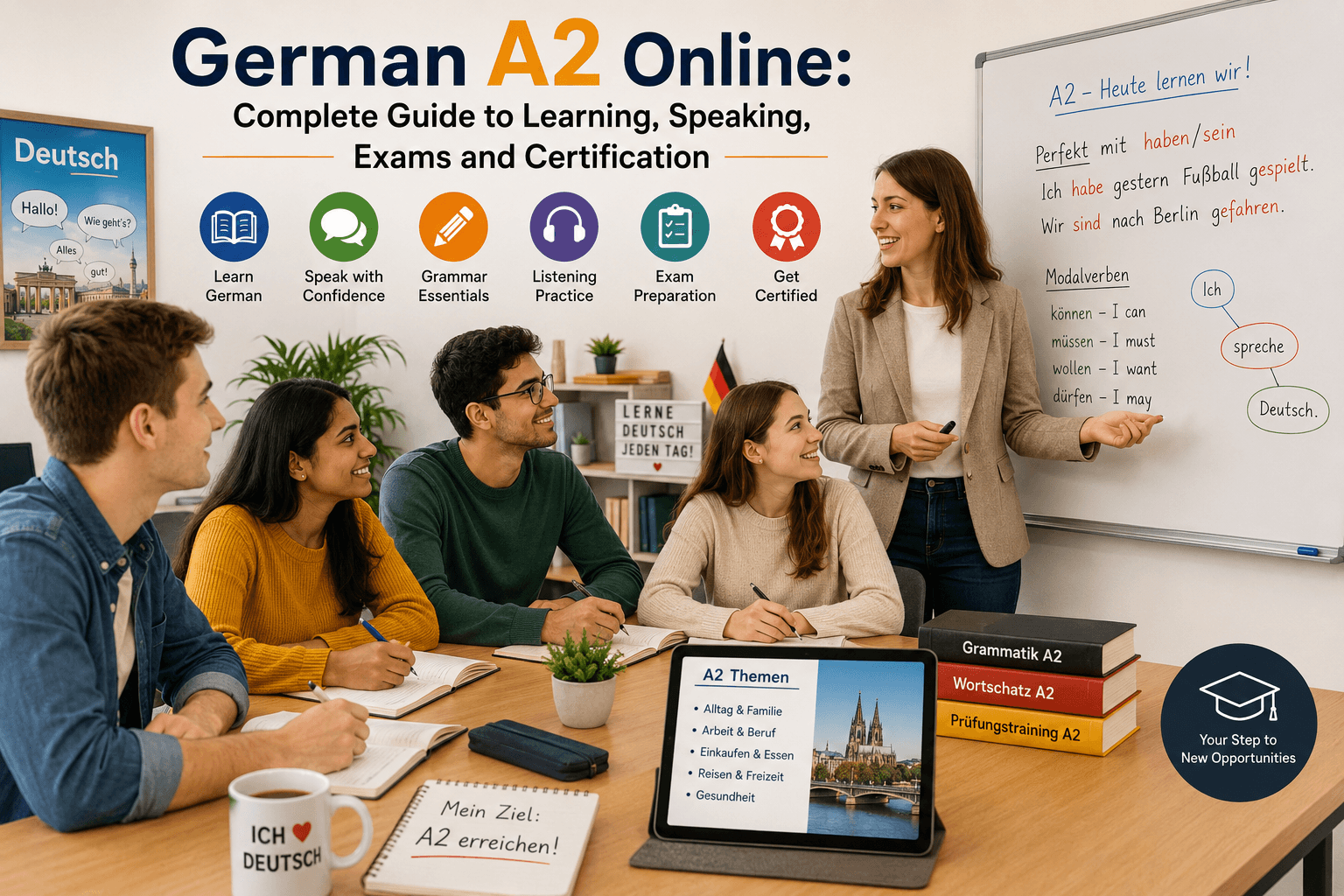
Perfect tense (Perfekt): Used frequently when talking about past experiences.
Ich habe gestern gearbeitet.
I worked yesterday.
Modal verbs: Words such as können, müssen, dürfen, wollen and sollen allow learners to express ability, obligation, permission and intention.
Ich muss morgen arbeiten.
I have to work tomorrow.
Dative and accusative cases: Understanding which case to use becomes increasingly important as sentences become more complex.
Prepositions: Learners should become comfortable with common accusative, dative and two-way prepositions.
Separable verbs: These occur constantly in everyday German.
Ich stehe jeden Morgen um sieben Uhr auf.
Comparative and superlative forms: Useful when comparing products, places, people or experiences.
Subordinate clauses: Connectors such as weil, dass and wenn help learners move beyond very short sentences.
Instead of memorising grammar rules independently, try using each new structure in conversations, writing exercises and realistic examples.
Real Conversations You Can Have at A2 Level
One of the biggest differences between A1 and A2 German is the range of conversations you can begin to manage.
At A2 level, you may be able to:
- Order food and ask questions in a restaurant
- Book a hotel room
- Ask for directions
- Explain a simple health problem
- Make or change an appointment
- Talk about your weekend
- Describe your previous holiday
- Discuss your hobbies
- Explain your daily work
- Make simple plans with friends
- Ask about products while shopping
- Handle basic conversations while travelling
You may still make grammatical mistakes or ask someone to repeat themselves. That is normal at A2. Successful communication matters more than producing perfect German every time.
German A2 Level
Want to understand what German A2 level actually means and what you should be able to do after reaching it? Our German A2 Level guide explains the language skills, learning expectations and competencies associated with this stage.
A2 German Conversation Starters
Many learners know vocabulary but struggle with one simple problem: How do I actually start a conversation?
Useful A2 German conversation starters include:
Wie war dein Wochenende?
How was your weekend?
Was machst du normalerweise am Wochenende?
What do you normally do on weekends?
Woher kommst du?
Where are you from?
Wie lange lernst du schon Deutsch?
How long have you been learning German?
Was machst du beruflich?
What do you do professionally?
Welche Musik hörst du gern?
What music do you like listening to?
Warst du schon einmal in Deutschland?
Have you ever been to Germany?
Was möchtest du nächstes Wochenende machen?
What would you like to do next weekend?
Learn conversation starters together with follow-up questions. This prevents conversations from ending after one sentence.
Most Common Mistakes A2 German Learners Make
Making mistakes is part of language learning, but recognising recurring errors can accelerate improvement.
1. Incorrect Word Order
German word order becomes more important at A2, particularly when learners begin using subordinate clauses.
For example:
Ich bleibe zu Hause, weil ich krank bin.
The verb moves to the end of the subordinate clause.
2. Confusing Accusative and Dative
Learners often understand the concept but struggle to apply it while speaking quickly.
Practising complete phrases rather than isolated articles can help.
3. Translating Directly From English
English sentence structures cannot always be transferred directly into German.
Try gradually learning to form thoughts using familiar German patterns instead of translating every sentence.
4. Ignoring Noun Gender
Learn nouns together with their articles:
der Tisch
die Wohnung
das Buch
This makes later case changes easier.
5. Avoiding Speaking Until Grammar Is Perfect
This is one of the biggest obstacles to progress. Speaking itself is part of learning grammar.
Common A2 German Conversation Mistakes
Conversation creates additional challenges because learners have less time to think.
Common problems include speaking too quickly, translating mentally, forgetting verb position, using English words whenever vocabulary is missing and giving one-word answers.
Suppose someone asks:
Was hast du am Wochenende gemacht?
Instead of answering:
Fußball.
Try:
Ich habe am Samstag mit meinen Freunden Fußball gespielt.
Building slightly longer responses helps develop conversational ability.
Building Confidence in A2 German Speaking
Confidence usually develops through repeated successful communication rather than through grammar study alone.
Try speaking German every day, even if only for 10–15 minutes.
Describe what you are doing:
Ich mache jetzt Frühstück.
Talk about yesterday:
Gestern habe ich einen Freund getroffen.
Talk about tomorrow:
Morgen werde ich ins Büro gehen.
You can also record yourself answering simple questions. Listen to the recording and identify pronunciation, vocabulary or grammar problems.
The objective is not to eliminate mistakes immediately. It is to become increasingly comfortable communicating despite them.
Community-Based Learning: German Language Exchange
Language exchange can complement formal German A2 online learning.
A typical language exchange pairs two people who want to practise each other's languages. For example, an English speaker learning German might practise with a German speaker learning English.
A useful 40-minute session could consist of:
20 minutes speaking German
20 minutes speaking English
At A2, conversation partners should keep topics manageable. Discuss your daily routine, food, travel, family, movies, hobbies or work rather than complicated political or technical subjects.
Language exchanges are especially useful for developing spontaneous speaking and listening skills.
One-on-One Tutoring vs. Group Classes for German A2
Both formats can work well, but they serve different learning needs.
One-on-One German Classes
Individual tutoring provides greater personal attention. Teachers can identify specific pronunciation, grammar and speaking problems and spend more time addressing them.
It can be particularly useful for learners with specific goals such as:
- Goethe A2 exam preparation
- German for healthcare
- German for IT professionals
- Relocation preparation
- Speaking improvement
- Interview preparation
Group German A2 Classes
Group classes provide opportunities to interact with several learners. Students can practise dialogues, role-plays and group activities.
They can also be more affordable than individual lessons.
The better option depends on your budget, schedule, learning speed and objective.
How to Prepare for the German A2 Exam
Most A2 German examinations assess four core abilities:
Reading (Lesen)
Listening (Hören)
Writing (Schreiben)
Speaking (Sprechen)
Preparation should therefore cover all four skills rather than focusing only on grammar.
Reading
Practise short emails, advertisements, notices, schedules, messages and simple informational texts.
Listening
Listen to announcements, everyday conversations and short dialogues at different speaking speeds.
Writing
Practise short messages and emails such as invitations, cancellations, requests and explanations.
Speaking
Practise introducing topics, asking and answering questions, making suggestions and responding to common everyday situations.
Timed mock tests are particularly valuable because knowing German and performing under examination conditions are two different skills.
German A2 Exam
Planning to take an A2 German examination? Explore our German A2 exam guide for useful information about exam preparation and the skills you need to practise across reading, writing, listening and speaking.
Goethe-Institut – German A2 Examination
Learners who want an internationally recognised assessment of their German skills can explore the Goethe-Zertifikat A2. The Goethe-Institut provides official information about the A2 examination, including the skills assessed and exam preparation materials.
Comparing Goethe vs. Other German A2 Certifications
The Goethe-Zertifikat A2 is one of the best-known German language qualifications internationally, but it is not the only option.
Depending on your location and purpose, learners may encounter qualifications from organisations such as Goethe-Institut, telc or ÖSD.
Before selecting an examination, consider:
- Recognition by your university or employer
- Visa or immigration requirements
- Examination availability in your city
- Exam format
- Cost
- Result processing time
- Your future German-language goals
There is no universally "best" A2 certificate for every learner. The right examination depends primarily on why you need certification.
If an organisation specifically requires a particular certificate, always confirm its current requirements before registering.
A2 German Certification: Is It Worth It?
Certification can be valuable when you need formal evidence of your German proficiency.
An A2 certificate may be useful for certain academic, professional, visa or personal purposes. It can also provide a measurable milestone before progressing to B1.
However, if you are learning German purely for personal interest, you do not necessarily need to take an examination after every CEFR level.
The most important question is:
Do you need proof of A2 German, or do you primarily need the language skills?
For many learners planning long-term study or employment in Germany, progressing toward B1 and B2 may ultimately be more valuable than stopping at A2 certification.
Best Apps for Reaching A2 German
Apps can support A2 learning effectively when used as supplementary tools.
They are particularly useful for:
- Vocabulary revision
- Spaced repetition
- Listening practice
- Short grammar exercises
- Pronunciation practice
- Daily learning habits
However, relying entirely on an app can leave gaps in spontaneous speaking and structured writing.
A balanced approach might combine:
Structured German A2 classes + vocabulary app + listening practice + regular conversation.
This creates repeated exposure to German in different contexts.
How to Use YouTube for A2 German Learning
YouTube can provide enormous amounts of German content, but random watching is less effective than structured learning.
Choose videos around A2 topics such as:
- German A2 listening practice
- German A2 conversations
- A2 grammar
- Goethe A2 speaking practice
- German pronunciation
- Slow German
- Everyday German conversations
A useful method is the three-listen technique.
First, watch without subtitles and identify the main idea.
Second, watch with German subtitles and note unfamiliar words.
Third, watch again without subtitles.
Then try summarising what you heard in simple German.
This converts passive video watching into active language practice.
German A2 Podcasts and Audio Courses
Podcasts are particularly valuable because real-life conversations do not come with subtitles.
At A2, start with slow or learner-oriented German audio rather than advanced native podcasts.
Listen for:
- Familiar vocabulary
- Verb forms
- Common expressions
- Sentence patterns
- Pronunciation
- Intonation
You do not have to understand every word.
If you understand the main topic and gradually recognise more phrases each week, your listening comprehension is developing.
Short daily listening sessions can be more effective than occasionally listening for several hours.
German A2 Resources for Specific Professions
Learners planning to work in Germany can begin building profession-specific vocabulary while studying general A2 German.
German for Healthcare Professionals
Healthcare learners can begin with vocabulary related to:
- Body parts
- Symptoms
- Appointments
- Medication
- Basic patient communication
- Hospital departments
- Dates and times
A2 alone may not satisfy professional or regulatory language requirements for healthcare work, but it can establish a foundation for later specialised learning.
German for IT and Technology Professionals
Technology professionals can practise vocabulary related to:
- Meetings
- Computers
- Software
- Projects
- Deadlines
- Emails
- Technical problems
- Workplace communication
German for Hospitality
Useful areas include reservations, food, customer requests, directions, payments and complaints.
German for Business Professionals
Learners can begin practising introductions, scheduling meetings, basic emails and workplace conversations.
The key principle is to build professional vocabulary on top of general German, rather than replacing general A2 learning with technical vocabulary.
A2 German: Business vs. Everyday Language
Everyday German and business German overlap, but their priorities differ.
Everyday A2 German focuses on situations such as shopping, transportation, family, travel, health and social interactions.
Business German introduces workplace situations such as:
Ich möchte einen Termin vereinbaren.
I would like to arrange an appointment.
Können Sie mir bitte eine E-Mail schicken?
Could you please send me an email?
Wann beginnt die Besprechung?
When does the meeting start?
At A2, learners should prioritise everyday German while gradually adding vocabulary relevant to their profession.
German Online Language Courses
If you are planning to continue learning German beyond A2, explore our German online language courses for structured learning across different proficiency levels. Build your speaking, listening, reading, writing, grammar and vocabulary skills as you progress through German.
German Job Interview Tips at A2 Level
A2 German is usually not enough for complex professional interviews conducted entirely in German. However, it can help you handle basic introductions and simple questions.
Prepare answers for questions such as:
Erzählen Sie etwas über sich.
Tell us something about yourself.
Was machen Sie beruflich?
What do you do professionally?
Warum möchten Sie in Deutschland arbeiten?
Why would you like to work in Germany?
Prepare short, clear answers instead of trying to memorise sophisticated paragraphs.
For example:
Ich arbeite seit drei Jahren als Softwareentwickler. Ich arbeite hauptsächlich mit Java und Python. Ich möchte in Deutschland arbeiten und meine Deutschkenntnisse weiter verbessern.
At A2, clarity is more important than complicated vocabulary.
Moving to Germany: How Much German Do You Really Need?
There is no single German level required for every person moving to Germany.
The amount of German you need depends on your reason for moving, profession, location, employer and applicable visa or regulatory requirements.
A2 German can make everyday situations considerably easier, including shopping, public transportation, basic appointments and simple social interactions.
However, B1 or B2 can provide much greater independence and may be expected for certain jobs or educational pathways. Regulated professions may have their own language requirements.
Always check the current official requirements applicable to your specific situation.
Tracking Progress in A2 German Learning
Students sometimes feel they are making no progress because language improvement happens gradually.
Instead of asking, "Am I fluent yet?" track smaller indicators.
Every two weeks, check whether you can:
- Speak for two minutes about your weekend
- Describe your daily routine
- Write a short email
- Understand a short German audio clip
- Explain something you did yesterday
- Ask and answer everyday questions
- Use new vocabulary naturally
- Understand more German without translating
You can also record yourself speaking on the same topic once every month. Comparing recordings after several months can reveal progress that is difficult to notice day by day.
Online German Classes
Looking for a flexible way to learn German with structured instruction? Our online German classes help learners develop practical communication skills while improving grammar, vocabulary, pronunciation, listening, reading and writing.
A Practical German A2 Online Learning Routine
Consistency is more important than occasional intensive study.
A practical weekly routine could include structured lessons several times a week, short daily vocabulary revision, 15–20 minutes of German audio or video, regular grammar practice and at least two speaking sessions.
Try to combine input and output.
Input means reading and listening to German.
Output means speaking and writing German.
Students who consume large amounts of German but rarely speak can develop strong passive understanding while continuing to struggle with conversation.
How Long Does It Take to Complete German A2?
The amount of time required varies considerably depending on your A1 foundation, weekly study hours, class frequency and exposure to German outside class.
A learner studying regularly and practising between lessons will usually progress faster than someone who attends classes but rarely uses German afterwards.
Rather than focusing entirely on completing A2 as quickly as possible, aim to finish the level with usable skills.
Being able to communicate comfortably at A2 is more valuable than simply completing an A2 textbook.
How German A2 Online Classes Can Help
A structured German A2 online course can provide a clear learning sequence instead of requiring students to assemble grammar lessons, videos and exercises independently.
Effective online A2 classes should ideally combine:
- Structured grammar instruction
- Vocabulary development
- Speaking activities
- Listening exercises
- Reading practice
- Writing correction
- Pronunciation feedback
- Real-life role-plays
- Progress assessments
- Exam preparation when required
Live interaction is particularly important because language learning is ultimately about communication.
Frequently Asked Questions About German A2 Online
1. How long does it take to reach A2 German?
The time required depends on your existing German knowledge, study frequency and amount of practice. Students who have completed A1 and continue with structured classes and regular self-study can usually progress considerably faster than complete beginners.
2. Is German A2 difficult to achieve?
A2 is achievable for most learners with a good A1 foundation. The main challenge is moving beyond memorised phrases and becoming comfortable forming your own sentences using German grammar and vocabulary.
3. Can I learn German A2 by myself?
Yes, self-study is possible using textbooks, apps, videos, podcasts and online exercises. However, classes or tutoring can be particularly useful for speaking practice, pronunciation, correcting mistakes and maintaining a structured learning plan.
4. What is the difference between A2 and B1 German?
At A2, you can communicate about familiar everyday situations using relatively simple language. At B1, you are expected to communicate more independently, explain experiences and opinions, and understand a wider range of conversations and texts.
5. What can I actually do with A2 German in real life?
At A2, you can handle many basic situations such as shopping, ordering food, asking for directions, making appointments, discussing your daily routine and having simple conversations about work, family, hobbies and travel.
6. What is the best way to learn German A2 from home?
Combine structured online lessons with vocabulary revision, grammar exercises, German videos, podcasts and regular speaking practice. Using German frequently is generally more effective than relying on a single learning resource.
7. How can I improve my German A2 speaking?
Speak regularly rather than waiting until your grammar is perfect. Practise describing your day, answering common questions, participating in role-plays and having short conversations with teachers, classmates or language-exchange partners.
8. Why is reading German easier than speaking at A2?
Reading gives you time to analyse words and sentences, whereas speaking requires you to recall vocabulary and grammar immediately. Regular conversation practice helps turn passive knowledge into active language ability.
9. How can I practise German A2 without a teacher?
You can practise through language exchanges, self-recording, shadowing German audio, speaking to yourself, writing short texts and using online conversation communities.
10. What is realistic to achieve with A2 German in six months?
Your progress depends on your starting level and study intensity. With consistent learning, you can substantially improve your ability to understand and communicate about familiar everyday situations.
11. Is it worth learning German if I only reach A2?
Yes. A2 can make travelling, everyday communication and living in a German-speaking environment easier. However, learners seeking greater academic or professional opportunities should usually consider progressing to B1 and B2.
12. What are the most common mistakes people make at A2 German level?
Common problems include incorrect word order, confusion between accusative and dative, incorrect noun gender, mistakes with verb conjugation and translating sentences directly from English.
13. How can I tell if I am really at A2 German level?
Assess all four skills: reading, writing, listening and speaking. You should be able to understand and communicate basic information about familiar subjects rather than relying entirely on memorised sentences.
14. What German vocabulary do I actually need at A2?
Focus on vocabulary related to family, work, shopping, food, health, transportation, travel, housing, appointments, hobbies, weather and other everyday situations.
15. What is the best German learning method to reach A2 quickly?
Use a combination of structured lessons, spaced vocabulary revision, grammar practice, listening and frequent speaking. Consistent daily exposure is usually more useful than occasional intensive study sessions.
16. How can I sound more natural at A2 German level?
Learn complete phrases and common expressions rather than individual words. Listen carefully to native pronunciation and sentence patterns and practise repeating them aloud.
17. Can I pass the A2 German exam in six months?
It can be possible depending on your starting level, study schedule and consistency. Learners should practise reading, writing, listening and speaking as well as completing mock examinations before taking the test.
18. What should I learn first at A2 German level?
Begin by strengthening your A1 foundation and then focus on high-frequency A2 vocabulary, past tense, modal verbs, accusative and dative structures, prepositions, word order and everyday conversation.
19. How often should I practise to reach A2 German?
Frequent practice is important. Even 20–30 minutes of focused German practice on most days can complement your regular classes and help maintain continuous exposure to the language.
20. Can I get a job in Germany with A2 German?
It depends on the profession, employer and individual position. Some international workplaces may operate mainly in English, while many customer-facing and German-speaking roles require stronger German.
21. What jobs can I do with A2 German?
Opportunities depend on your professional qualifications and the employer's language requirements. A2 can be useful in some entry-level or internationally oriented environments, but B1 or B2 German can significantly expand your options.
22. How much German do I need to work part-time in Germany?
There is no single level that applies to every part-time job. Roles involving frequent customer interaction generally require stronger German than positions where communication is limited or the workplace operates in English.
23. Should I list A2 German on my CV or job application?
Yes, if A2 accurately represents your current ability. Clearly stating your CEFR level gives employers a better understanding of your German proficiency. If you are currently studying B1, you can mention that separately.
24. Can I study in English and live in Germany with A2 German?
Many international programmes are taught in English, but German can still be valuable outside the classroom. A2 can help with shopping, transportation, appointments and everyday interactions, while progressing to B1 or B2 can provide greater independence.
25. How can I go from A2 to B1 German faster?
Continue building vocabulary while increasing your exposure to real German. Read longer texts, listen to German regularly, practise speaking about unfamiliar topics and start expressing reasons, experiences and opinions rather than relying only on short factual sentences.
Final Thoughts
German A2 is more than the second step on a language-level chart. It is the stage where many learners begin moving from studying German to actually using German.
Grammar remains important, but progress at A2 increasingly depends on listening, speaking and repeated exposure to realistic situations.
Use structured German A2 online classes as the foundation, then reinforce your learning through podcasts, YouTube, apps, language exchanges, professional vocabulary and regular conversation practice.
Do not wait until your German is perfect before speaking. Make mistakes, identify them, correct them and continue communicating.
That process is what gradually turns A2 knowledge into practical German ability.
Related Posts