

GPA Calculation Method: When students in India start planning higher education in Germany, one question almost always appears sooner or later:
“My marks are 70%. Is that good enough?”
Interestingly, German universities don’t actually judge your admission chances based on your percentage alone. Instead, they rely on a standardized GPA Calculation Method. This is where many applicants become confused. A student with 75% might receive a German grade of 2.3, while someone with 65% may get around 2.7. Naturally, this creates panic because students think their marks were reduced.
In reality, nothing negative has happened. The GPA Calculation Method simply translates your academic performance into the German grading scale so universities can compare applicants from different countries fairly.
Understanding this process early can save you a lot of stress and also help you choose universities more realistically.
Why Germany Uses a GPA Calculation Method
Germany receives applications from all over the world — India, China, Europe, the United States, and many other countries. Every education system has a different grading style. Some use percentages, some use letter grades, and others use credit-based systems.
Without a common evaluation system, universities would have no way to compare applicants fairly. Therefore, they use a universal GPA Calculation Method to convert all academic records into one standard scale.
This means the admission committee never directly compares your 72% with someone else’s 3.5 GPA from another country. They first convert both using the GPA Calculation Method and then evaluate.
The German Grading Scale
Before you understand the GPA Calculation Method, you must know how grades work in Germany. Unlike India, smaller numbers are better.
| Grade | Meaning |
|---|---|
| 1.0 – 1.5 | Excellent |
| 1.6 – 2.5 | Good |
| 2.6 – 3.5 | Satisfactory |
| 3.6 – 4.0 | Pass |
So if your converted grade is 2.4, that is actually a positive result. Many Indian students wrongly assume anything above 2 is poor. In Germany, a 2.5 is still considered a decent academic performance.
The GPA Calculation Method is designed specifically to place you accurately on this scale.
The Formula Behind the GPA Calculation Method
German universities generally use what is known as the Modified Bavarian Formula. This is the official GPA Calculation Method used for international applicants.
Formula:
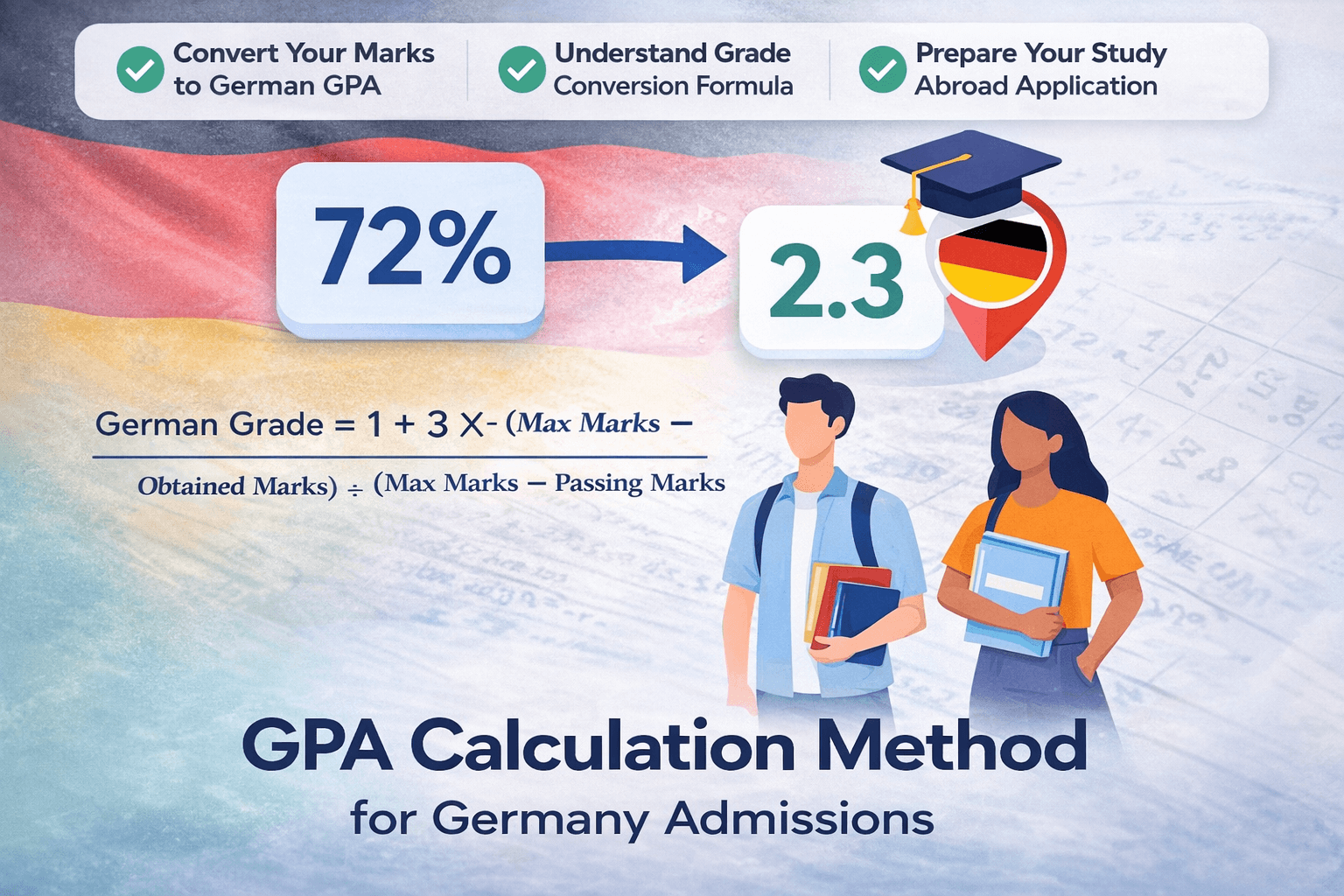
German Grade = 1 + 3 × (Maximum Marks − Obtained Marks) ÷ (Maximum Marks − Passing Marks)
At first glance the formula looks complicated, but it actually makes sense. It measures how far your marks are above the minimum passing level and converts that distance into the German scale.
Example 1: A Typical Student (72%)
Let us understand the GPA Calculation Method with a real example.
Marks obtained: 72%
Maximum marks: 100
Passing marks: 40
Applying the GPA Calculation Method:
1 + 3 × (100 − 72) ÷ (100 − 40)
1 + 3 × 28 ÷ 60
1 + 1.4
= 2.4
So a 72% student becomes a 2.4 in the German system.
That is considered good and eligible for many programs.
Example 2: 65% Student
Now let’s apply the GPA Calculation Method again.
1 + 3 × (100 − 65) ÷ 60
1 + 3 × 35 ÷ 60
1 + 1.75
≈ 2.75
This student still qualifies for a large number of public universities.
This shows why you should not judge your chances only by percentage.
Example 3: 80% Student
Using the GPA Calculation Method:
1 + 3 × (100 − 80) ÷ 60
1 + 3 × 20 ÷ 60
1 + 1
= 2.0
Now the student has a strong academic profile.
What Happens for CGPA Students
Engineering students often have CGPA instead of percentage. In this case, the GPA Calculation Method first converts CGPA into percentage based on the official conversion rule of the university.
For example:
If 8.0 CGPA × 9.5 = 76%
Then 76% is inserted into the GPA Calculation Method formula.
If a university does not provide a conversion formula, the evaluators analyze semester marks individually before applying the GPA Calculation Method.
What Actually Influences Your Converted Grade
Many students think the simply averages marks. It does not.
It considers:
• all semesters
• core subject performance
• credit weightage
• passing criteria
This is why two students with the same percentage may receive slightly different German grades after the calculation is applied.
Backlogs and Attempts
Backlogs worry students a lot. However, Method does not automatically reject a student because of backlogs.
Repeated attempts may slightly lower the converted grade, but admission is still possible. Many successful applicants had one or two backlogs during their degree.
Minimum Grade Needed
You do not need extremely high marks.
| German Grade | Result |
|---|---|
| Below 2.5 | Good chances |
| 2.6 – 3.0 | Acceptable |
| Above 3.2 | Limited options |
The GPA Calculation Method often shows that 65–70% students still have realistic opportunities.
Common Mistakes Students Make
Students sometimes affect their GPA Calculation Method result unintentionally:
• uploading incomplete marksheets
• calculating percentage incorrectly
• not including grading scale
• missing semester results
Providing clear documentation helps ensure the GPA Calculation Method reflects your real performance.
Can You Predict Your Grade?
Yes. Before applying, you can roughly estimate your grade using the GPA Calculation Method formula. This helps you shortlist universities wisely and avoid unnecessary application expenses.
Do 12th Marks Matter?
For master’s admission, school marks are generally not part of the GPA Calculation Method. Only bachelor’s degree performance is evaluated.
Can Work Experience Help?
Work experience does not change the GPA Calculation Method, but it strengthens your profile. German universities consider internships and projects positively, especially for applied science courses.
Why Students Panic Unnecessarily
Most confusion happens because students compare German grades with Indian percentages. A student sees a 2.7 and assumes failure, but under the German system it is acceptable.
The GPA Calculation Method does not reduce your marks — it expresses them in another academic language.
Planning Your Application Correctly
If you understand the GPA Calculation Method early, you can:
• choose appropriate universities
• set realistic expectations
• prepare better documentation
• reduce anxiety
Students who ignore the GPA Calculation often apply blindly and face disappointment. Students who understand it plan strategically.
Final Understanding
The GPA Calculation Method is simply a translation system. It allows German universities to evaluate international students fairly and consistently.
A 70% student from India may appear average locally but becomes competitive after the GPA Calculation conversion. Instead of worrying about percentage, applicants should interpret their profile using this standardized approach.
Once you understand the GPA Calculation Method, the admission process becomes clearer, more predictable, and far less stressful. It also helps you focus on other important factors like course relevance, projects, and motivation letter rather than only marks.
In short, the GPA Calculation Method is not a barrier.
It is a bridge that connects your education system to the German university system.
FAQ – Germany Admissions & Grade Conversion (Students’ Common Questions)
1. Do German universities look at percentage or converted grade?
German universities evaluate the converted academic grade, not your original percentage. The conversion helps them compare international applicants fairly.
2. Is 65% enough to study in Germany?
Yes. Many public universities accept students between 60–70% depending on course and profile strength.
3. What is considered a good academic score in Germany?
A converted grade around 2.0–2.5 is generally considered strong for most programs.
4. Will my 12th marks affect my Master’s admission?
No. For postgraduate programs, only your bachelor’s degree performance is evaluated.
5. Are backlogs a problem for Germany admission?
Not necessarily. A few backlogs are acceptable, but repeated attempts may affect university selection.
6. Can I apply with 6.5 CGPA?
Yes, many students with similar scores successfully receive admission, especially in applied science universities.
7. Do private universities have different requirements?
Yes. Private universities may have slightly flexible academic criteria compared to public universities.
8. What documents are required before applying?
You need transcripts, degree certificate, passport, CV, and a statement of purpose.
9. What is the role of APS certificate?
The APS certificate verifies academic authenticity for Indian students before applying to German universities. You can read the full process here:
10. Is German language compulsory?
Not always. Many Master’s programs are taught in English, but knowing basic German helps daily life.
11. What level of German is recommended before going?
A1 or A2 is recommended for living comfort and part-time job opportunities.
12. What is Uni-Assist?
It is an evaluation portal used by many universities to verify academic eligibility before admission.
13. How long does admission evaluation take?
Usually 4–6 weeks, but it may be longer during peak admission season.
14. What is VPD?
It is a pre-evaluation document issued after checking academic qualifications. Detailed explanation here:
15. Can I apply to multiple universities at once?
Yes, students typically apply to 5–8 universities to increase chances.
16. Is IELTS mandatory?
Many universities require IELTS 6.0–6.5, but some accept other English proofs.
17. What is the official university database in Germany?
You can verify recognized universities on the DAAD website:
18. Do I need a blocked account?
Yes, students must show financial proof through a blocked account before visa.
19. How much money is required in the blocked account?
The required amount is updated by German authorities every year. You can check the latest blocked account requirement and explanation here:
20. Can work experience improve admission chances?
Yes. Relevant internships or job experience significantly strengthen applications.
21. Do German universities conduct interviews?
Some courses conduct online interviews, especially management and specialized programs.
22. When should I start the application process?
At least 8–10 months before the intake.
23. What happens after admission?
After admission, you apply for a visa appointment and prepare financial documents.
24. Where can I check visa requirements?
Official visa requirements are published by the German embassy:
25. Should I learn German before visa?
Yes, basic German preparation helps daily life, accommodation search, and part-time job opportunities after arrival. You can also understand the required preparation level here: