

Uni Assist Germany Guide: Planning to study in Germany involves more than choosing a university and preparing IELTS. Before many universities even review your profile, international students must go through an important academic verification step handled by uni assist. Students who understand this process early avoid delays, missed intakes, and unexpected rejections.
This guide explains the full uni assist Germany process in clear terms — what it is, why universities use it, how to apply, required documents, VPD meaning, fees, and the common mistakes Indian students make.
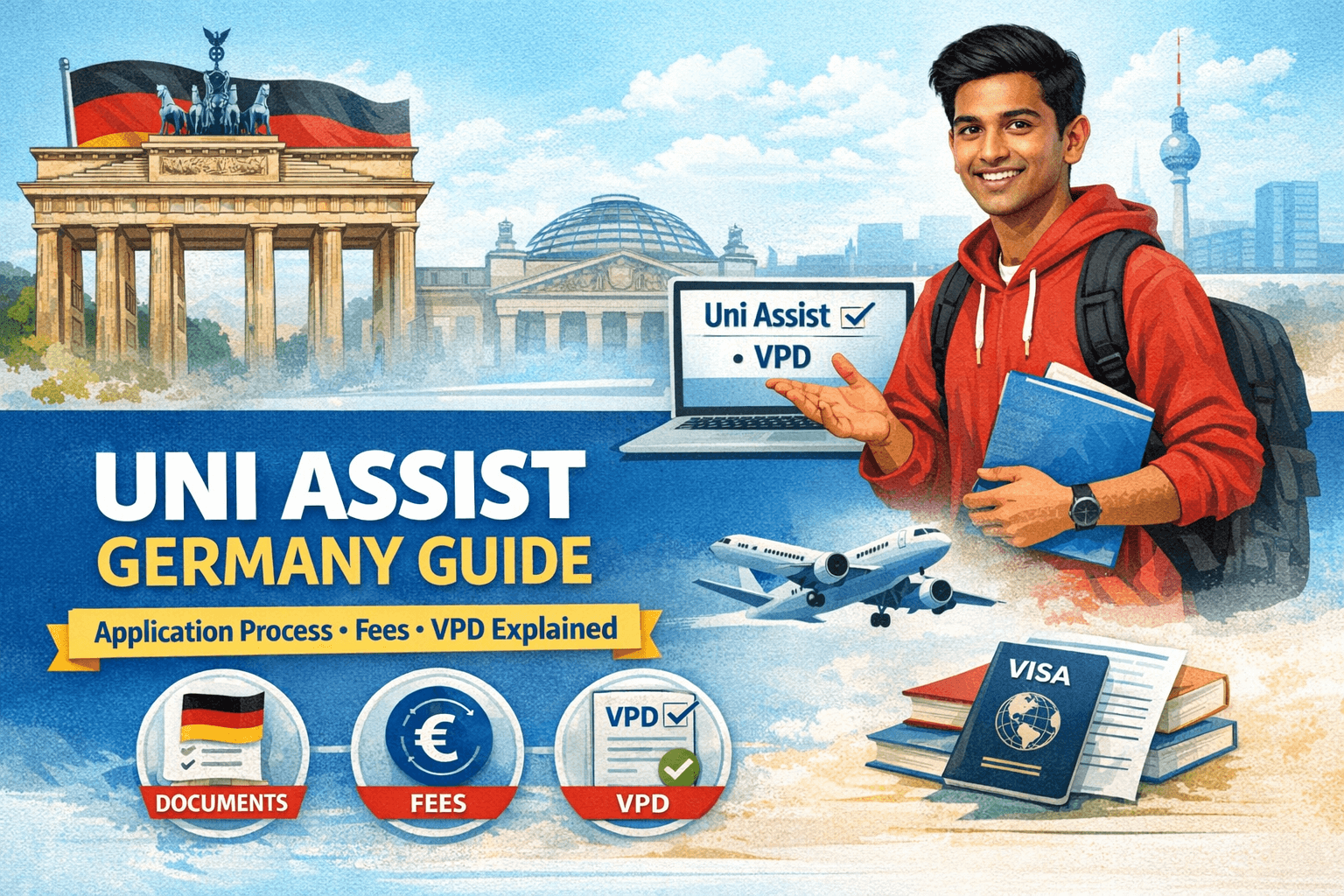
What is Uni Assist?
Uni assist (University Application Service for International Students) is a centralized academic evaluation organization in Germany. Its job is to check whether foreign educational qualifications match German higher-education standards.
German universities receive applications from hundreds of countries. Each country follows different grading systems, boards, and degree structures. Instead of every university individually verifying documents, they rely on uni assist to standardize the evaluation.
Important to understand:
-
It is not a university
-
It does not give admission
-
It does not issue visa approval
It only checks whether your academic background qualifies you to apply.
After verification, your application is forwarded to the university for academic selection.
Before applying to German universities, students should carefully understand how the evaluation process works. Many universities require international applicants to submit their academic records through the official evaluation platform. You can check the application portal directly here:
For universities that request a preliminary eligibility certificate, applicants must obtain a VPD (Vorprüfungsdokumentation). This document confirms whether your previous education is recognized for higher education in Germany and also shows your converted German grade. The official explanation of VPD and when it is required is available here:
Preparing these steps early helps students avoid missing admission deadlines and prevents delays in the visa process.
Why German Universities Use It
Germany’s public universities receive extremely high application volumes. Popular courses such as Mechanical Engineering, Computer Science, AI, Automotive Engineering, and Management may receive thousands of international applications each intake.
Universities therefore outsource document checking to uni assist. They verify:
• Authenticity of academic records
• Academic equivalence
• Credit requirements
• Grading conversion
• Eligibility for master’s or bachelor’s programs
This means a strong profile can still be rejected if eligibility requirements are not met at this stage.
Universities That Require Uni Assist
A large number of public universities and universities of applied sciences require it, especially for:
-
Master’s programs
-
Bachelor’s programs
-
Foundation (Studienkolleg)
-
Conditional admissions
Some universities need it only for certain departments, so always check the admission page carefully before applying.
What is VPD (Vorprüfungsdokumentation)?
One of the most confusing parts for students is VPD.
VPD stands for Vorprüfungsdokumentation (Preliminary Review Documentation).
Instead of sending your application directly to the university, uni assist evaluates your academic records and issues a certificate stating:
• You are eligible for higher education in Germany
• Your converted German grade
• Recognized academic qualification
You then upload this certificate in the university portal.
Very important:
VPD is not admission.
It is only eligibility verification.
Many top universities now require VPD before you even apply.
Step-by-Step Uni Assist Application Process
Step 1: Create an Account
Register on the portal and fill details exactly as per passport.
Step 2: Choose Course & University
Search the program and check whether direct evaluation or VPD is required.
Step 3: Upload Documents
Upload clear scanned copies of all academic records.
Step 4: Pay Application Fee
Your application is processed only after payment confirmation.
Step 5: Evaluation
Academic eligibility and grade conversion are checked.
Step 6: Forwarding / VPD Issuance
If eligible, your application is sent to the university or a VPD is issued.
Typical processing time: 4–6 weeks.
Documents Required
Students must prepare documents carefully. Most rejections happen due to documentation errors.
Academic Records
• 10th marks card
• 12th marks card
• Bachelor degree certificate
• Semester marksheets
• Transcripts
Supporting Documents
• Passport
• CV/Resume
• English proficiency (IELTS/TOEFL/MOI)
• German certificate (if required)
• Statement of Purpose (some universities)
If documents are not in English or German, certified translations are necessary.
Application Fees
Current fee structure:
-
€75 for first university
-
€30 for each additional university
The fee covers only document evaluation. It does not include semester fee, visa fee, or APS.
Note: Fee is non-refundable even if rejected.
Processing Time
Normal period: 4–6 weeks
Peak season (May–July): 6–8 weeks
Students should apply early. Universities consider the date when evaluation finishes, not the upload date.
Common Mistakes Students Make
Applying Near Deadline
Late applications often miss admission cycles.
Missing Semester Marksheets
Every semester record is required.
Wrong Course Choice
German universities require subject relevance between bachelor’s and master’s.
Ignoring VPD Requirement
Applications are rejected immediately if required VPD is not uploaded.
Poor Document Scans
Blurred or cropped documents cause delays.
Grade Conversion in Germany
Germany follows a 1.0 to 4.0 grading system.
1.0 = Best
4.0 = Pass
Your CGPA or percentage is converted using a formula, and this grade heavily influences admission.
Difference Between Uni Assist and APS
Students often confuse these two processes.
Uni assist: Academic eligibility check for university
APS: Academic authenticity verification for visa
Both are independent steps and often both are required.
You can read a related visa documentation explanation here:
https://iifls.com/aps-certificate-germany-step-by-step-process/
After Approval – What Happens Next?
Once your application passes evaluation:
-
University reviews application
-
Admission letter issued
-
Open blocked account
-
Get health insurance
-
Book visa appointment
For understanding visa preparation stages, students also refer to:
And for language eligibility requirements:
When Should You Apply?
Winter intake students should begin between April and May.
Apply early especially if:
• Average CGPA
• Applying to multiple universities
• Need conditional admission
• Competitive programs
Early application gives time to reapply if necessary.
Why Students Get Confused
Students assume admission depends only on IELTS and CGPA. In reality, documentation accuracy is equally important. Many applicants lose an entire year simply due to avoidable mistakes.
Interestingly, research on international education events and preparation workshops (such as global student academic gatherings like this:
) shows that documentation clarity is one of the biggest factors affecting successful overseas admissions.
Similarly, academic studies on multilingual academic readiness
highlight that structured preparation improves acceptance rates.
Even universities now analyze student application data to predict admission outcomes and academic success:
This is why Germany maintains a centralized verification system.
Students planning admission should also understand exam preparation and certification requirements, especially internationally recognized exams. A helpful explanation is available here:
Final Advice
Germany offers one of the most accessible high-quality education systems in the world, but it is documentation-driven. Students who carefully prepare and apply early usually succeed without stress.
Uni assist is simply the academic gateway. Once cleared, the rest of the process — admission, blocked account, and visa — becomes significantly smoother.
Start early, submit correct documents, and verify university instructions carefully. A well-prepared application not only improves admission chances but also prevents visa delays later.
Uni Assist Germany – Frequently Asked Questions (FAQs)
1. What is uni assist in Germany?
Uni assist is a centralized organization in Germany that evaluates international students’ academic qualifications and checks whether they are eligible to apply to German universities. It forwards eligible applications to universities after verification.
2. Is uni assist mandatory for all German universities?
No. Not every university requires it. However, many public universities and universities of applied sciences require uni assist evaluation for international students.
3. Does uni assist give admission?
No. Uni assist does not grant admission. It only verifies your academic eligibility. The final admission decision is made by the university.
4. What is VPD in uni assist?
VPD (Vorprüfungsdokumentation) is a preliminary evaluation certificate issued after your documents are verified. You must upload this certificate while applying to certain German universities.
5. How long does uni assist take to process an application?
Normally it takes about 4–6 weeks. During peak admission season (May to July), it may take up to 6–8 weeks.
6. What are the uni assist application fees?
The first university application costs €75 and each additional university costs €30. The fee is non-refundable.
7. Can I apply to multiple universities through uni assist?
Yes. You can apply to several universities in one account. You just need to pay the additional fee for each university.
8. What documents are required for uni assist?
You typically need:
-
10th and 12th marksheets
-
Bachelor degree and transcripts
-
Passport copy
-
Language certificate (IELTS/TOEFL/German)
-
Resume (CV)
9. Do I need APS before uni assist?
No. Usually you apply to universities first. APS is mainly required later during the visa process, not during the university application stage.
10. Can uni assist reject my application?
Yes. If your academic qualification does not meet German standards, or if documents are incomplete, your application can be rejected before reaching the university.
11. What happens after uni assist approval?
Your application is forwarded to the university. Then the university evaluates your profile and decides whether to issue an admission letter.
12. Is uni assist required for a master’s degree in Germany?
Many master’s programs require it, especially public universities. But some universities handle applications directly without uni assist.
13. Do I need to send physical documents?
Most universities now accept online document upload. However, a few programs may still request notarized copies, depending on the university.
14. Can I edit my application after submission?
You can edit your application before payment. After payment and submission, changes usually require contacting their support team.
15. How does uni assist calculate German grades?
They convert your percentage or CGPA into the German grading system (1.0 best to 4.0 pass) using an official conversion formula.
16. What if my university is not listed in uni assist?
If a university is not listed, it means you must apply directly through that university’s own application portal.
17. Can I get a refund if rejected?
No. The evaluation fee is non-refundable even if your application is rejected.
18. When should I apply through uni assist?
For winter intake, it is best to apply between April and May. Early application reduces the risk of missing deadlines.
19. Is uni assist required for a German student visa?
No. Uni assist is for university admission. For visa processing, you usually need an admission letter and APS verification.
20. Can uni assist delay my admission?
Yes, if you apply late or submit incomplete documents. Since universities consider the evaluation completion date, delays may cause you to miss an intake.