APS Certificate Germany: If you are planning to study in Germany, you will very quickly hear one term again and again — the APS certificate.
Many students prepare for IELTS, short-list universities, and even write their SOPs, but then suddenly discover that their application cannot move forward because the APS certificate is missing. This surprises a lot of applicants because Germany did not always require it earlier. However, for Indian students today, the APS certificate is one of the first things that needs to be completed before admission and visa procedures begin.
Simply put, the APS certificate is an academic verification report. It confirms to German universities and visa authorities that your marksheets and degree certificates are genuine and actually issued by a recognized Indian institution.
Germany receives a very large number of applications from India every year. Instead of each university individually checking documents, the verification is centralized. That centralized check is what the APS certificate provides.
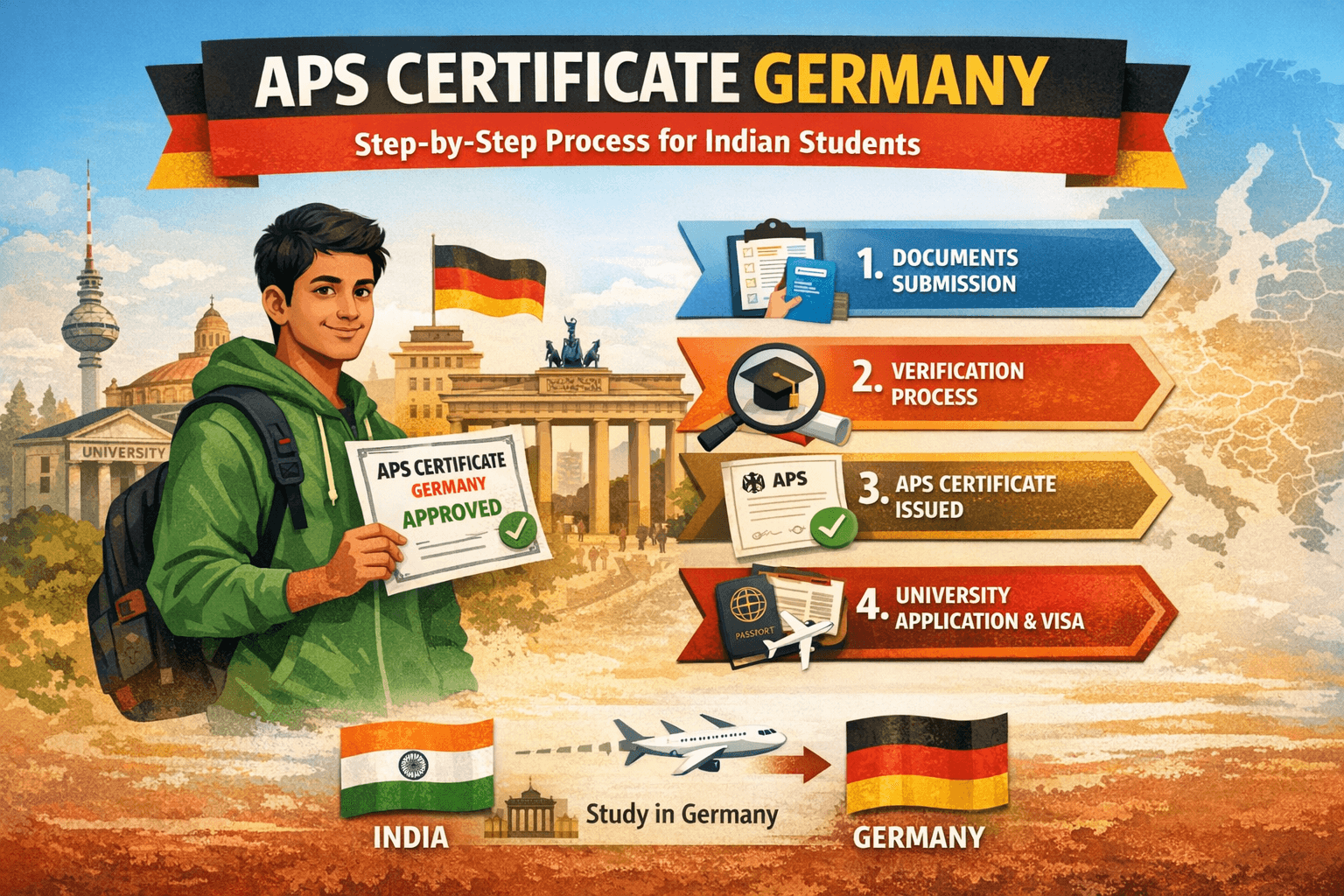
What Exactly Does the APS Do?
APS stands for Academic Evaluation Centre. It operates in cooperation with the German Embassy in New Delhi. Their job is not to give admission and not to approve visas. Their job is only one thing — to verify your academic records.
They check:
-
whether your college exists
-
whether your marksheets are authentic
-
whether your degree is recognized
-
whether your academic background meets basic eligibility
After the verification is completed, they issue the APS certificate. Universities trust this report and use it while evaluating applications.
This is why most German universities now ask for the APS certificate even before reviewing your profile.
Why Germany Introduced This System
Earlier, German universities individually contacted Indian colleges to confirm student records. That process took months and caused serious delays. Some universities even stopped processing applications because they could not verify documents on time.
The APS certificate solved this problem. Instead of 50 universities contacting one college, the verification happens once through APS, and the result can be used everywhere.
So the purpose is not to make the process harder. It is actually to make admission processing faster and more reliable.
Who Needs It?
The APS certificate is required for most Indian applicants who want to study in Germany, including:
-
Bachelor’s applicants
-
Master’s applicants
-
Students applying through Uni-Assist
-
Students attending Studienkolleg (foundation programs)
Even if a university gives conditional admission, they may still ask you to submit the APS certificate before final enrollment.
Documents You Should Prepare First
Before you even open the application portal, collect all academic records carefully. Most delays happen because students rush this step.
You typically need:
-
Passport copy
-
Class 10 and 12 marksheets
-
Degree certificate (if graduated)
-
Semester marksheets
-
Official transcripts
-
Aadhaar card copy
-
Application form printout
-
Payment confirmation
Clear and readable copies are extremely important. Blurred scans or missing semesters often lead to follow-up emails and waiting time.
The Application Process (Realistic Step-by-Step)
1. Online Registration
First, you create an account on the official APS India website. Enter your name exactly as written in your passport. Even a small spelling difference later creates confusion.
2. Fill the Application Form
You will enter academic details — university name, course, passing year, and marks. Take your time here. Incorrect academic data is one of the most common reasons verification gets delayed.
3. Pay the Verification Fee
After submitting the form, you pay the processing fee through bank transfer. Save the payment receipt. APS will not begin checking your documents until payment is confirmed.
4. Send Documents by Courier
You must print the application form and courier your documents to the APS office. The process does not start until they physically receive the envelope.
This step is important — many students assume online submission alone is enough. It is not.
5. University Verification
This is the longest stage. APS contacts your college or university directly. Sometimes universities respond quickly; sometimes they take time. During this stage you simply have to wait.
6. Possible Clarification
APS may email you asking for additional proof or clarification. Always reply promptly. Many delays happen because students miss emails.
7. Receiving the Report
Once verification is completed, you receive the APS certificate digitally by email. This document is what you will upload to university portals and carry for visa processing.
How Long Does It Take?
There is no fixed timeline because the waiting period mainly depends on your college’s response speed. Some verifications finish faster, while others take longer.
Because of this uncertainty, students are advised to apply for the APS certificate early — ideally before university deadlines approach.
Common Mistakes Students Make
From experience, most delays come from small avoidable errors:
-
missing semester marksheets
-
mismatched name spelling
-
unclear document copies
-
incomplete transcripts
-
wrong passport number
Taking an extra day to double-check documents can save several weeks later.
Is It Admission Approval?
No. The APS certificate does not give admission.
It only confirms that your education is authentic and eligible for evaluation. Universities still decide admission based on grades, course requirements, and language qualifications.
Where You Will Use It
After receiving the APS certificate, you will use it in multiple places:
-
University applications
-
Uni-Assist portal
-
Visa appointment documents
Some universities even ask for the certificate number while you fill out the application form.
After You Receive It
Once you get the APS certificate:
-
Save both soft and printed copies
-
Upload it wherever required
-
Carry it for your visa interview
Think of it as your academic clearance document. After this step, you can proceed smoothly with admission and visa procedures.
Practical Advice
Students often leave this step for the end, assuming admission comes first. In Germany’s process, it is usually the opposite. Starting the APS certificate early prevents last-minute panic close to deadlines.
Keep checking your email regularly after applying. Most communication happens only through email, and quick replies help the process move faster.
Final Thoughts
For Indian students, the APS certificate has become an essential first stage in the Germany education pathway. It does not guarantee admission, and it does not replace language tests, but it allows universities and visa authorities to trust your academic background.
Once this verification is completed, the remaining steps — admission, blocked account, and visa — become much more straightforward.
Students who understand the process early and prepare documents carefully usually avoid unnecessary delays and stress during the application cycle.
Frequently Asked Questions – APS Certificate Germany
1. What is the APS in Germany and why is it required?
The APS certificate Germany is an academic verification report used by German universities to confirm the authenticity of Indian educational documents. Many students first explore international education options and language pathways before applying, similar to the guidance discussed here:
2. Is it mandatory for Indian students?
Yes, for most German universities and for the student visa process, the APS certificate Germany is mandatory before applications are processed.
3. When should I apply for the APS ?
You should apply as soon as you decide to study in Germany, ideally before submitting university applications, to avoid delays close to deadlines.
4. How long does the APS process take?
The processing time depends mainly on how quickly your Indian university responds to verification requests made by APS.
5. Can I apply to German universities without the APS ?
Some universities allow initial application submission, but evaluation usually does not proceed without the APS certificate Germany.
6. Does the APS guarantee admission?
No. The APS certificate Germany only verifies academic authenticity. Admission decisions depend on grades, eligibility criteria, and course requirements.
7. Is the APS required for a German student visa?
Yes. The APS certificate Germany is commonly requested during the student visa appointment as part of the document checklist.
8. What documents are required for the APS ?
Students generally submit marksheets, degree certificates, transcripts, passport copy, and payment confirmation for the APS certificate Germany process.
9. Is German language proficiency required for the APS ?
No. Language requirements are assessed by universities separately. The APS certificate Germany focuses only on academic verification.
10. Can diploma holders apply for the APS ?
Yes, but eligibility depends on whether the diploma qualification meets German higher education recognition standards.
11. What happens if my university does not respond to APS verification?
The APS certificate Germany processing time may increase because APS waits for official confirmation from the issuing institution.
12. Will APS contact students directly?
In some cases, APS may contact students by email for clarification or additional documents before issuing the APS certificate Germany.
13. Can I use one APS for multiple universities?
Yes. Once issued, the APS certificate Germany can be used to apply to multiple German universities.
14. How will I receive the APS ?
The APS certificate Germany is usually sent digitally by email. Students should keep both soft and printed copies.
15. Is name mismatch an issue in the APS ?
Yes. Differences in name spelling across documents can delay verification and may require additional proof or clarification.
16. Do I need original documents for the APS ?
Printed copies are usually sufficient, but APS may request additional proof if clarification is needed.
17. What should I do after receiving the APS ?
After receiving the APS certificate Germany, students should upload it to university portals and include it in their visa documentation.
18. Is the APS required for Studienkolleg programs?
Yes. Students applying for Studienkolleg or foundation programs in Germany usually need the APS certificate Germany.
19. Why did Germany introduce the APS system?
Germany introduced centralized academic verification to improve trust and efficiency in international education. The importance of verified cross-cultural education systems is discussed in detail here:
20. Does the APS certificate Germany help with future careers in Europe?
Indirectly, yes. Verified education allows students to progress smoothly into higher studies and careers in Europe, similar to broader European career pathways explained here: